 2026 Platinum
Table of Contents
- Links Golf: What It Is, How It Plays, and Why Scotland Has More of It Than Anywhere Else
- Where the Word Comes From
- What Makes a Course a True Links
- How Links Golf Plays Differently
- Natural Links vs Modern Links
- Where to Play Golf in Scotland
- Why Links Courses Play Better in Winter
- What to Wear for Links Golf
Royal Dornoch captures the essence of true links
Links Golf: What It Is, How It Plays, and Why Scotland Has More of It Than Anywhere Else
The word “links” is one of the most misunderstood terms in golf. It does not simply mean a golf course. It describes a specific type of coastal landscape, a distinctive way of playing the game, and, for many golfers, the purest form of the sport there is.
Where the Word Comes FromThe word ‘links’ has nothing to do with the links of a chain or anything connecting one thing to another. It derives from the Old English word hlinc, meaning a ridge or rising ground. The word first appeared in print around 931 AD. In Scots, it came to describe the undulating, sandy coastal land that sat between the sea and the fertile farmland further inland. This was land that was largely useless for crops. The soil was too sandy, too wind-battered, too uncooperative for agriculture. But it grew a particular type of short, fine grass, browntop bent and red fescue, that created a firm, fast-draining surface ideal for hitting a ball along the ground. Golf did not choose links land. Links land chose golf. The game developed on this terrain because it was the only ground available. It was common land, owned by nobody in particular, and the sandy soil meant it could be played in winter when every other surface was waterlogged. The connection runs deeper than geography. A 1651 text, in the Scots spelling of the day, describes Dornoch as having ‘the fairest and largest linkes of any pairt of Scotland, fitt for archery, goffing, ryding, and all other exercise.’ Long before formal golf clubs existed, these common lands were shared spaces for recreation. Golf simply happened to stick. The fact that it was predominantly a winter and spring game in Scotland for centuries is often forgotten. The first Open Championship was held in October. Summer play was actually banned on some courses because the land was needed for grazing and the grass grew too long to find a ball. Over time, the word broadened. Today, ‘the links’ is used colloquially to refer to any golf course, and place names such as Lundin Links in Fife predate golf entirely. But in its truest sense, a links remains what it has always been: coastal, sandy, windswept, and gloriously unpredictable. Worth noting, too, that the word is already plural. One plays a links, not a ‘link.’ Pedantic? Perhaps. But these things matter in golf. |
What Makes a Course a True Links
There are only 247 true links courses in the world. Scotland has 85 of them, which is more than any other country. That figure comes from the book True Links by George Pepper and Malcolm Campbell, which catalogued every genuine links course on the planet, and is echoed by the Links Association, which uses the British Golf Museum’s definition of linksland: ‘a stretch of land near the coast characterised by undulating terrain, often associated with dunes, infertile sandy soil and indigenous grasses such as marram, sea lyme and the fescues and bents.’
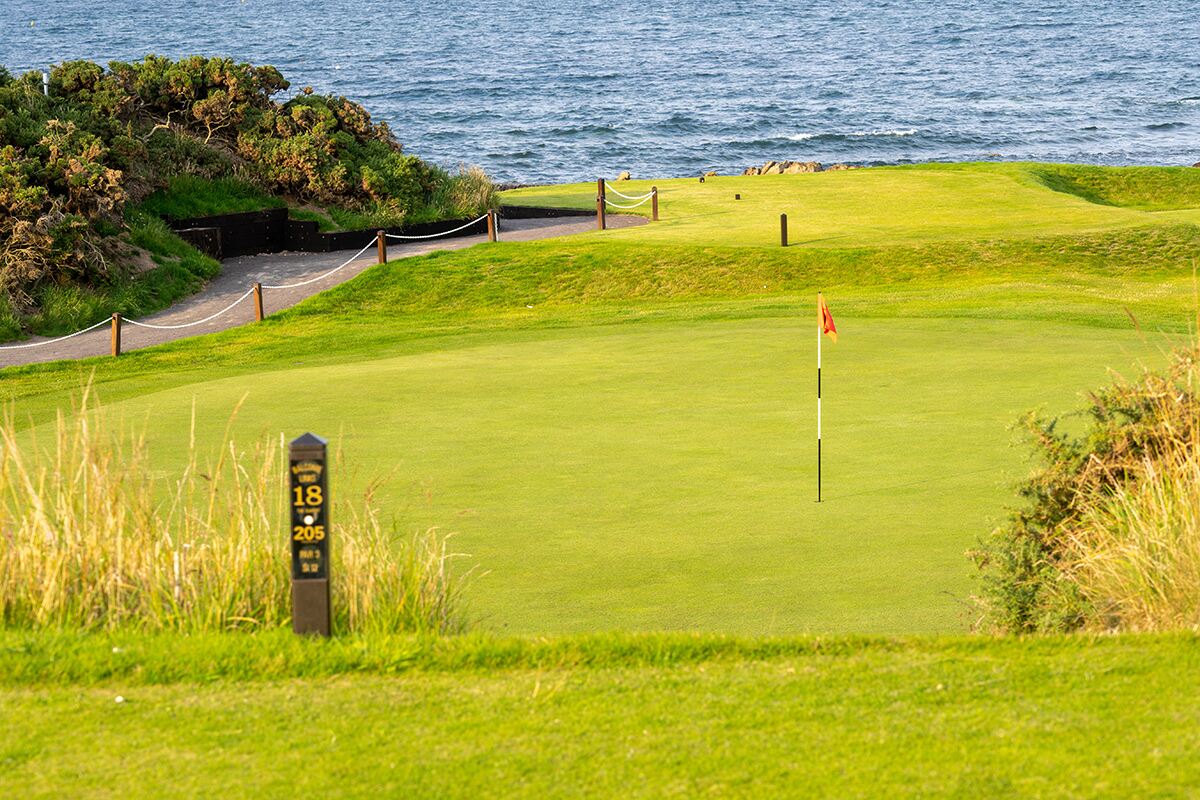
The Balcomie Links at Crail, a true links test
A true links shares a set of characteristics that set it apart from parkland, heathland, or any other type of golf course. The turf is firm and fast, sitting on sandy soil that drains almost immediately after rain. There are few if any trees. The terrain is naturally undulating, shaped over millennia by wind and tide rather than by earth-moving machinery. Bunkers tend to be deep, steep-faced pot bunkers rather than the shallow, raked traps found on inland courses. And the wind is a constant companion, not an occasional inconvenience.
The landscape is raw and exposed. There are no cart paths winding between manicured flower beds. The rough is thick, wild, and genuinely punishing. The greens are firm and receptive primarily to balls that arrive along the ground rather than through the air. It is golf stripped back to its essentials.
Of the 247 true links worldwide, 211 sit in the British Isles. The remainder are scattered across the Netherlands, New Zealand, Australia, and the United States, where the Bandon Dunes resort in Oregon (Bandon Dunes, Pacific Dunes and Old Macdonald) accounts for three of the four American courses that qualify. Courses that carry ‘links’ in their name but do not sit on genuine linksland, Pebble Beach Golf Links being the most famous example, are more accurately described as coastal courses. Pebble Beach is a spectacular golf course. But much of it runs through woodland on non-sandy soil, and its playing surfaces lack the indigenous fescue and bent grasses that define genuine links turf. The name is an aspiration, not a description.
How Links Golf Plays Differently
The single biggest adjustment for any golfer stepping onto a links for the first time is learning to use the ground. On a parkland course, the standard approach shot is a high ball that lands on the green and stops. On a links, that shot will land, bounce, and disappear over the back of the green into trouble. The ground is too firm and the greens too fast for an aerial game to work consistently.
The bump and run becomes essential. Rather than launching a lofted wedge from 100 yards, a golfer on a links might take a seven-iron or even a six-iron, land the ball 30 yards short of the green, and let it run up to the pin. If you are using wedges, ensure they are low bounce wedges to clip the ball of the firm surface. It is a different skill entirely, requiring feel, imagination, and trust in the turf. For golfers raised on soft, watered inland courses, it can feel counterintuitive. For those who master it, there is no more satisfying way to play the game. Practise using anything from a seven-iron to a hybrid around the greens, and start thinking about the approach as a putt with extra loft. That mental shift changes everything.
Wind management is the other great leveller. Coastal links courses are exposed to winds that can change speed and direction multiple times during a single round. A 150-yard shot that calls for a comfortable nine-iron in still air might need a punched six-iron into a headwind an hour later. Club selection becomes an exercise in constant recalibration. The old Scottish advice to ‘take one more club and swing easy’ has never been more relevant than on a links course with the wind up.
Then there is the bounce. On firm links turf, the ball will kick and run in ways that feel random at first but become readable with experience. A fairway that tilts towards a bunker will feed the ball straight into it. A green that slopes away from the approach will reject anything that arrives too fast. Reading the contours is a skill that develops over rounds, not minutes, and it is one of the genuine pleasures of links golf.
One golfer who understood this better than most was Sam Cooper, who set himself the challenge of playing every single one of the 225 links courses in Britain. He and his wife converted a van, set off from Hoylake, and spent the best part of two years visiting every true links from the Channel Islands to the Shetlands. His observation, repeated at almost every stop, was that links golf rewards the player who thinks before they swing. Position is everything. Power, for once, is not.
A caddie helps enormously. On an unfamiliar links, a good caddie will know the blind tee shots, the hidden bunkers, the subtle green breaks, and the spots where an apparently safe shot can run into serious trouble. At many of Scotland’s championship links, that local knowledge is worth four or five shots over eighteen holes. If a caddie tells you a putt breaks two cups to the left, trust them.
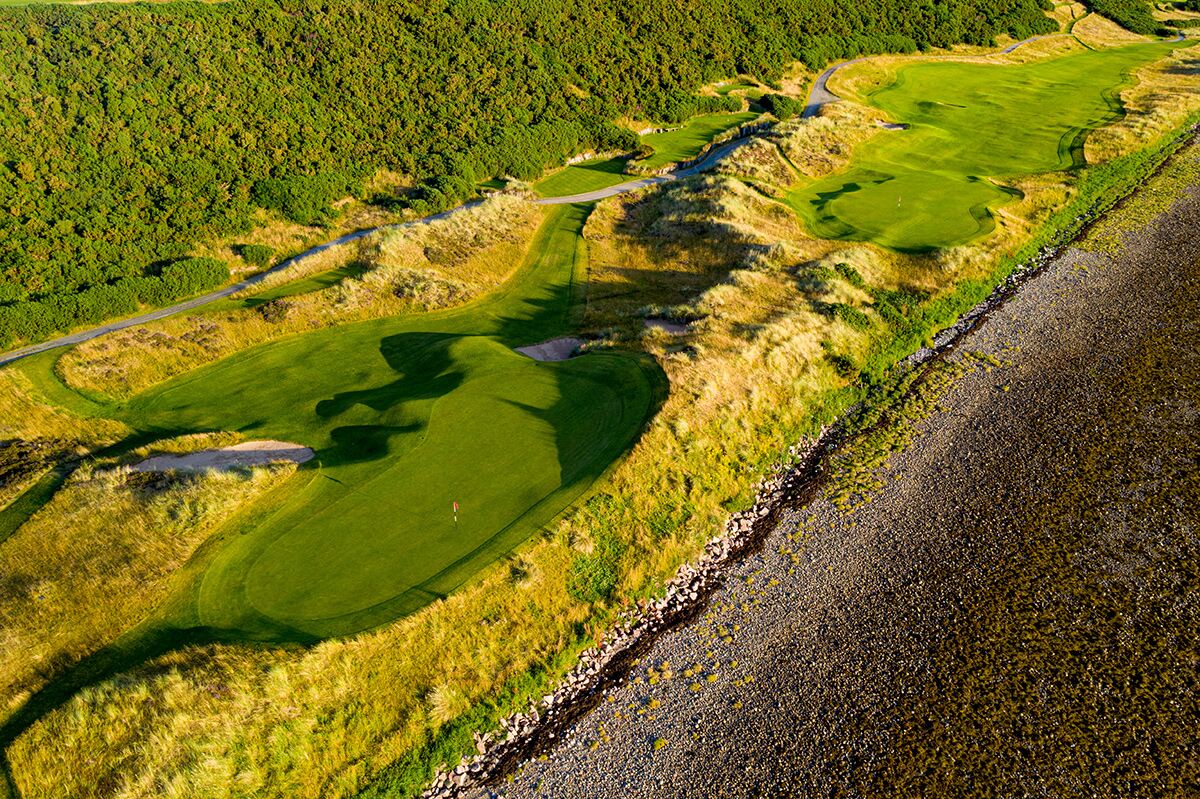
Castle Stuart’s spectacular modern links
Natural Links vs Modern Links
An important distinction exists between natural links courses and modern courses built on links-style land. The Old Course at St Andrews, Prestwick, and Machrihanish are natural links. The terrain was the terrain. Nobody moved millions of tonnes of earth to create the landscape. The holes were discovered rather than designed, routed through dunes and along coastlines that had been shaped by nature over thousands of years.
Then there are the modern links courses. Kingsbarns, which opened in 2000 near St Andrews, plays beautifully and has all the visual hallmarks: firm fairways, coastal views, pot bunkers, rippling terrain. But a considerable amount of earth was moved to create it, and the land was sculpted to feel like linksland rather than simply being linksland. Dumbarnie Links, Castle Stuart, and Renaissance in East Lothian fall into a similar category, though each varies in the degree of intervention involved.
This is not snobbery. It is recognition that the natural links courses of Scotland are unrepeatable. Nobody will ever build another Old Course. The geological and climatic conditions that created those original links landscapes took thousands of years. They are, in the truest sense, irreplaceable.
But the modern links courses are superb golf courses in their own right, and several have hosted major professional tournaments. One telling observation from golf architects is that new courses need time to settle. Fresh turf takes five to ten years to knit in properly. A course that feels slightly artificial in its opening seasons can bed into its landscape beautifully given patience. Kingsbarns is a good example: first-time visitors in 2002 sometimes walked away unconvinced. Nobody says that now.
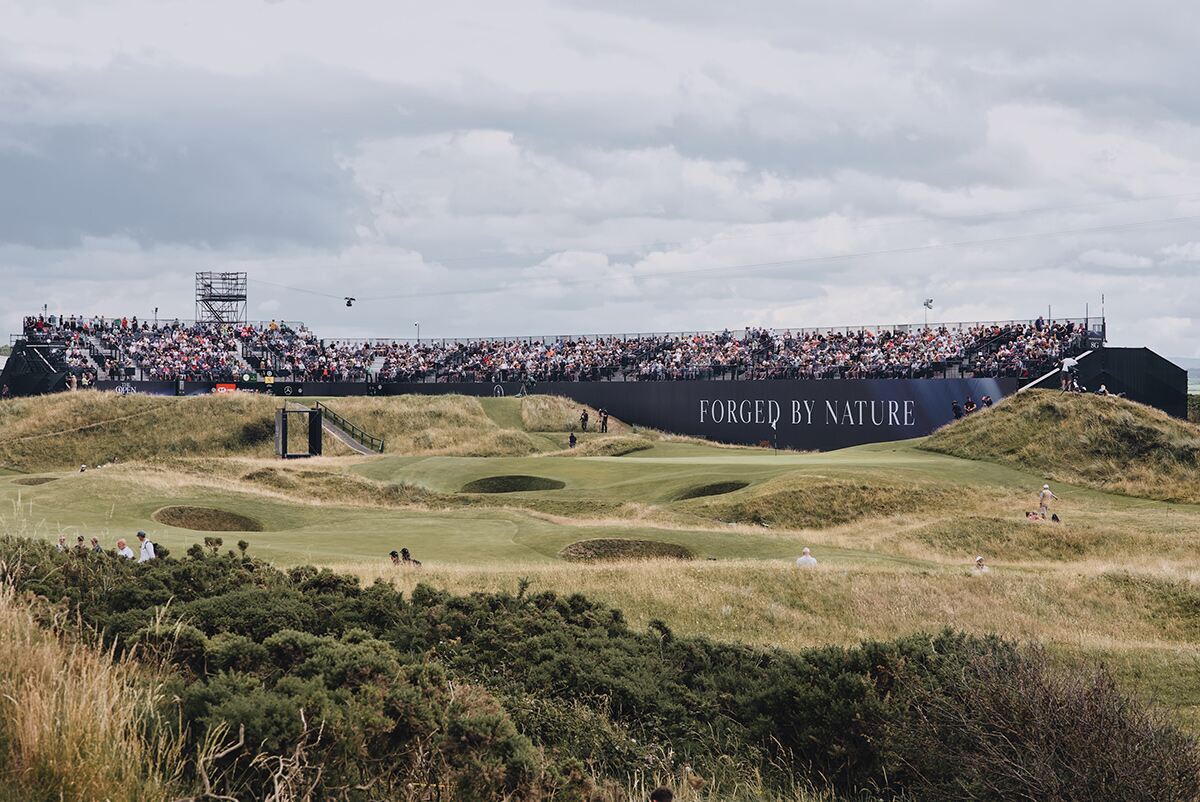
Dramatic landscape at Royal Troon, an Open venue
Where to Play Golf in Scotland
For the golfer who has never played a links course, Scotland is the obvious destination. With 85 true links within a country roughly the size of South Carolina, the concentration of quality is unmatched anywhere in the world. And the beauty of it is the range. At one end, the Old Course at St Andrews and Muirfield represent the pinnacle. At the other, courses like Elie, Crail Balcomie, and Lundin Links offer the same quality of turf, the same firm fairways, the same coastal winds for a fraction of the green fee. There is no correlation between price and quality on Scotland’s links courses. Some of the finest rounds of golf available anywhere in the world cost less than fifty pounds.
East Lothian, marketed as Scotland’s Golf Coast, has one of the most concentrated clusters of links golf on earth. Within thirty miles of Edinburgh sit Muirfield, Gullane (three courses), North Berwick, Dunbar, and Kilspindie, all genuine links, while modern additions like Archerfield, Renaissance, and Craigielaw offer links-style golf of exceptional quality. The microclimate here is notably drier than the west coast, and the courses drain superbly through winter. Several golfers from Edinburgh hold second memberships down the coast specifically because links turf plays so well in the colder months.
Fife and St Andrews need little introduction. The seven courses managed by the St Andrews Links Trust include the Old Course, the New, and the Jubilee, which locals often rate as their favourite. Beyond St Andrews, the Kingdom of Fife offers Crail, Leven Links, Lundin Links, and Elie, all true links with their own distinct character. The Jubilee at £43 in winter is one of the best value rounds of links golf anywhere.
The Ayrshire coast runs from Turnberry in the south through Royal Troon, Prestwick, Western Gailes, and Dundonald. Many of these courses are connected by the railway line, and it is entirely possible to play a different championship links each day without driving more than a few miles. Prestwick hosted the first twelve Open Championships from 1860. Royal Troon staged the most recent Scottish edition. The corridor between them is as dense with golfing history as anywhere on earth.
Further north, the Highlands are increasingly regarded as one of Scotland’s most underrated golf destinations. Royal Dornoch anchors the region, regularly ranked among the finest courses in the world. But Brora, Golspie, Tain, Fortrose and Rosemarkie, and Nairn are all genuine links, and the scenery is extraordinary. Castle Stuart and its planned neighbouring course near Inverness are adding to the appeal. The connections are good too: London to Inverness is a straightforward flight, and you can be on the first tee within an hour of landing.
In Aberdeenshire, Royal Aberdeen and Cruden Bay are the headline acts, but Balnagask Links, a true links course run by the local authority for barely more than £30, offers one of the most affordable genuine links experiences in the country. The region’s courses are often quieter than their East Lothian and Fife counterparts, with availability at shorter notice.
And for golfers willing to venture further, Scotland’s islands and peninsulas deliver links golf of extraordinary character. Machrihanish on the Kintyre Peninsula has what is widely considered the most famous opening drive in golf, directly across the beach. Shiskine on Arran is a twelve-hole links with views across to Ailsa Craig. Askernish on South Uist was rediscovered and restored in 2008 from an Old Tom Morris original. Even Whalsay in the Shetland Isles qualifies: a proper golf course on rugged clifftop terrain with sheep for company, a green fee of about £10, and quite possibly nobody else on the course. These are not courses one stumbles upon. They reward the journey.
Why Links Courses Play Better in Winter
One of the less obvious advantages of links land is that it plays beautifully in winter. The sandy soil drains so efficiently that even after heavy rain, a links course will be playable within hours. Coastal courses rarely see snow for any extended period, and frost is less persistent than on inland ground. In over twenty years on Scotland’s east coast, full snow closures have been vanishingly rare.
Winter links golf brings its own pleasures. Green fees drop considerably from October through March. The Old Course ballot odds improve significantly in the shoulder months. The courses are quieter, the light can be spectacular, and there is a particular camaraderie among golfers who brave the elements together. The nineteenth hole feels properly earned after a round in December.
Some courses get creative with winter. Cruden Bay operates a ‘frost course’ on particularly cold mornings, keeping the front edges of greens closely mown and bringing a wee par-three 19th hole into play, tucked between the 12th and 13th right out on the Aberdeenshire coast. It is 130 yards to a thin sliver of green with the rocks and crashing sea behind it. Beautiful, and genuinely exclusive to winter visitors.
For roughly every 5°C drop in temperature, a golf ball travels around two yards less. It is a modest difference, but worth factoring in. More significant is the impact of cold air on the golfer: stiff muscles, numb fingers, and thicker clothing can all affect the swing. Layering properly is not just about comfort. It is about performance.
What to Wear for Links Golf
Links golf demands more from clothing than any other form of the game. The weather changes faster than on any inland course, and there is no shelter from the wind. A round that starts in bright sunshine can turn to driving rain within thirty minutes. The golfer who is not prepared for that will have a miserable back nine. Layering is everything, and each layer has a job to do.
Base layer (shirt)
A long-sleeved shirt is the smartest starting point for any links round. The g.Kelso cotton roll neck for men and the g.Fern for ladies keep the wind off the arms, sit beautifully under a mid-layer, and offer +40 UV protection for when the sun does decide to show on the back nine. For those who prefer a collared option, the g.Max long-sleeve pique polo for men and the g.Misha for ladies provide the same full-sleeve coverage in a performance fabric that wicks moisture and manages heat as conditions change. Choose fabrics that will cope with a morning that starts at 8°C and finishes at 16°C.
Mid layer
This is where links golf dressing becomes an art. A merino wool zip neck or lambswool sweater provides warmth without restricting the swing, and comes on and off easily between holes as conditions shift. Natural fibres like merino and lambswool breathe better than synthetics in the variable conditions found on a links, keeping the body comfortable whether walking into a headwind on the front nine or sheltered in a hollow on the back. The g.Coll lambswool zip neck is a popular choice for its lightweight warmth. For ladies, the g.Amira merino zip neck offers the same versatility. For something with built-in weather resistance, a water-repellent lined sweater like the g.Samuel or s.Sirocco for men, or the g.Penelope for ladies, will keep the rain beading off without adding bulk.
Gilet
A wind-resistant gilet is one of the most useful pieces of kit on a links course. It provides core warmth while leaving the arms completely free for the swing, and it packs down to almost nothing in the bag. The g.Johnstone and g.Carlton are both excellent options for men. For ladies, the g.Calla gilet does the same job with a more tailored cut. On those days when the wind has a bite to it but you do not need a full jacket, a gilet over a mid-layer is the perfect combination.
Outerwear (jackets)
A lightweight, packable waterproof golf jacket is non-negotiable on a links course, even on days when the forecast looks clear. Links weather does not respect forecasts. For summer links golf, the Sunderland s.Whisperdry Pro-Lite provides waterproof protection that is light enough to forget you are wearing it. For the autumn and winter months, when horizontal rain and a 30 mph wind arrive together, the s.Typhoon and s.Valberg offer more substantial thermal defence. All Sunderland waterproofs carry a lifetime waterproof guarantee. For ladies, the s.Whisperdry Thermal Lined Whistler is a go-to for cooler months and the s.Killy for summer rounds. Umbrellas, it should be said, are largely pointless on an exposed links. The wind will destroy them within minutes.
Accessories
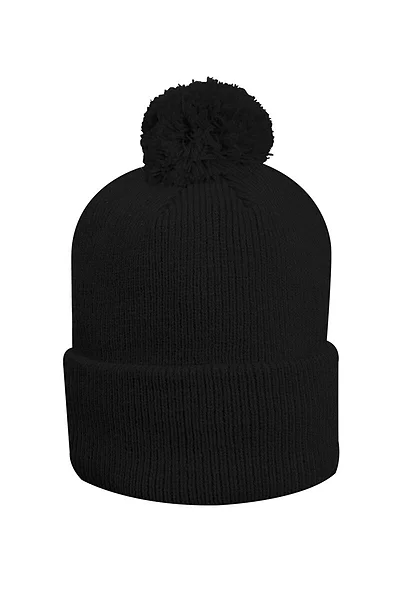
The small things make a big difference on a links. A g.Malabar thermal lined beanie tucked in the bag is worth at least three shots. Keep the wind out of your ears and you keep your concentration. The s.Waterproof Bucket Hat is a practical alternative that keeps rain off the face without the formality of a peaked cap.
Two Sunderland accessories that are genuine life-savers on a winter links: the s.Mittens and the s.Thermal Neck warmer. The mittens are windproof and showerproof with a Heatweaver thermal fleece lining and inner storm cuffs, and there is even a pocket for hand warmers on the coldest days. Slip them on between shots and your grip stays warm and responsive when it matters. The neck warmer does what a scarf does without the bulk and without getting in the way of the swing. Between the two of them, they take the edge off even the rawest coastal morning.
Perhaps most importantly, pack an open and imaginative mind. Leave the lob wedge in the car. Trust the ground. And prepare for the most honest, exhilarating form of golf there is.
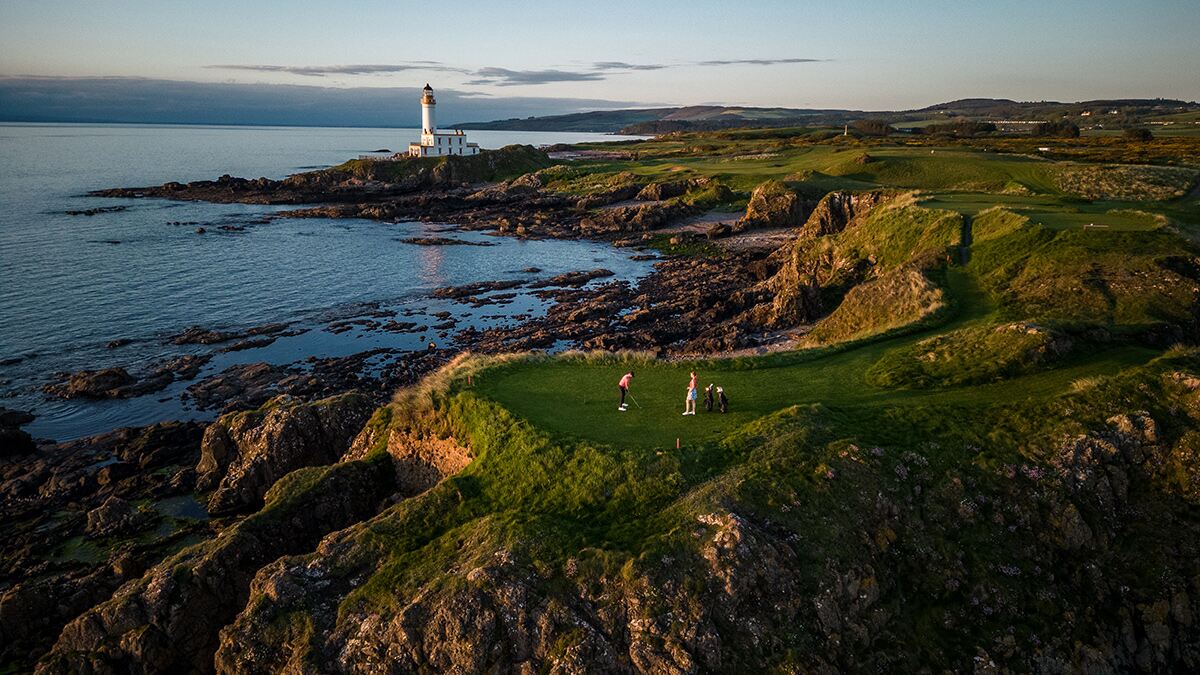
Turnberry’s iconic 9th, one of the most iconic par 3s in golf history
WHAT TO WEAR FOR LINKS GOLF