 2026 Platinum
Table of Contents
- Two dates that made Scotland
- A craft refined slowly
- The hip flask at the turn
- The myth of 18 holes and 18 drams
- Loch Lomond and The Open
- For the links, for the parkland
- A life inside the blending vats
- The Real McCoy and a French beetle
- Distillery trails worth a detour
- A jigger from St Andrews
- The best dram is the one in your hand
Two dates that made Scotland
The first written record of whisky in Scotland comes from 1494. Friar John Cor, a Tironensian monk at Lindores Abbey in Fife, was granted eight bolls of malt by the Exchequer with which to make aqua vitae, Latin for “the water of life.” That phrase became uisge beatha in Gaelic and, by the late 1700s, whisky in English.
The first written record of golf comes thirty-seven years earlier, in 1457, when King James II of Scotland banned “ye golf” by Act of Parliament because it was distracting young men from archery practice. Within a generation, two of Scotland’s greatest cultural exports had been documented for the first time. Both, as it happens, attracted a slightly disapproving tone from the authorities. They have done rather well since.
That the two dates fall so close together is more than a coincidence of the historical record. Whisky and golf grew up in the same country, among the same people, on the same patches of ground. The geography that produced the links and the lowland farms also produced the malted barley and the soft water. The communities that worked the land in winter walked it with clubs in summer.
A craft refined slowly
Making whisky and playing golf are crafts that reward patience and resist shortcuts. The distiller learns the subtleties of the cask, the impact of malted barley, the length of fermentation, the slow influence of climate on a maturing spirit. The golfer learns the subtleties of the course, the speed of the green, the angle of the wind and the slow influence of years of practice on a swing.
Both crafts depend on understanding variables that cannot fully be controlled. The weather will do what it does. The wood will do what it does. Skill, in both cases, is about working with what is given rather than against it.
The dram improves with time spent in oak. The golfer improves with time spent on grass. Neither happens quickly. Neither can be hurried by money or by impatience. This is perhaps why both have survived so well in a culture that values long memories and longer winters.
The hip flask at the turn
Long before halfway houses stocked single malts behind the counter, the hip flask was the golfer’s companion at the turn. Pewter or silver, usually engraved, passed between playing partners as part of the rhythm of the round. A nip at the ninth was not drinking so much as a gesture of hospitality. It still is, at the older Scottish clubs where the custom survives.
Whisky was the most common companion. The flasks held other things too. Sherry on a cold morning at Muirfield. Drambuie at Loch Lomond. Madeira in the wood-panelled rooms of clubhouses where dress codes still mattered. Even Benedictine, the spiced French liqueur, made its way into the occasional silver flask, though it never quite caught on the way whisky did.
The custom is older than the modern halfway house. When the only refreshment between holes was what one carried, the flask was practical as much as ceremonial. Today, with bacon rolls and hot soup available at the ninth on most decent courses, the flask has become a deliberate choice rather than a necessity. The golfers who still carry one tend to do so for the small theatre of it: the click of the cap, the offer to a playing partner, the brief warmth on a cold tee.
The myth of 18 holes and 18 drams
There is a story, popular enough to have travelled well beyond Scotland, that a bottle of whisky contains exactly 18 shots, and that this is why golf is played over 18 holes. It is a charming theory. It is also, sadly, entirely false.
The World Golf Museum in St Andrews has debunked this politely on more than one occasion. The actual reason for 18 holes is that in 1764, the Society of St Andrews Golfers, later the Royal and Ancient, reduced their course from 22 holes to 18. Several of the original holes were judged too short to be worth keeping. The rest of the world eventually followed the St Andrews lead. A standard 70cl bottle of whisky yields roughly 25 to 30 measures depending on the pour, which is at least seven too many for a sensible round of golf.
The myth survives because it is more romantic than the truth. Most golfers would rather believe the game and the bottle were designed in deliberate harmony. The reality, that a Scottish club tidied up its course in the eighteenth century and accidentally set a global standard, is less satisfying somehow. Both are good stories. Only one is true.
Loch Lomond and The Open
Whisky and championship golf came together formally in 2007, when Loch Lomond Whiskies became the Official Spirit of The Open Championship. The Open is golf’s oldest major, dating from 1860 at Prestwick. A Scottish whisky becoming its official spirit was the kind of detail that felt inevitable in retrospect.
Loch Lomond’s signature style, in the hands of master distiller Michael Henry, leans into fruit, honey and a touch of soft smoke. The distillery has an unusual production setup with both straight-neck and swan-neck stills, which allows for a wider range of flavours than most single malts can produce at the distillation stage rather than relying solely on maturation. Henry has collaborated on releases with Colin Montgomerie, Louis Oosthuizen and Lee Westwood, each tour player working with the distillery on a whisky that reflects their own taste.
For those visiting The Open in person, the official whisky offers an obvious souvenir. For those watching at home, a glass of Loch Lomond 18 in front of the Sunday afternoon coverage is one of the more civilised ways to spend a July weekend.
For the links, for the parkland
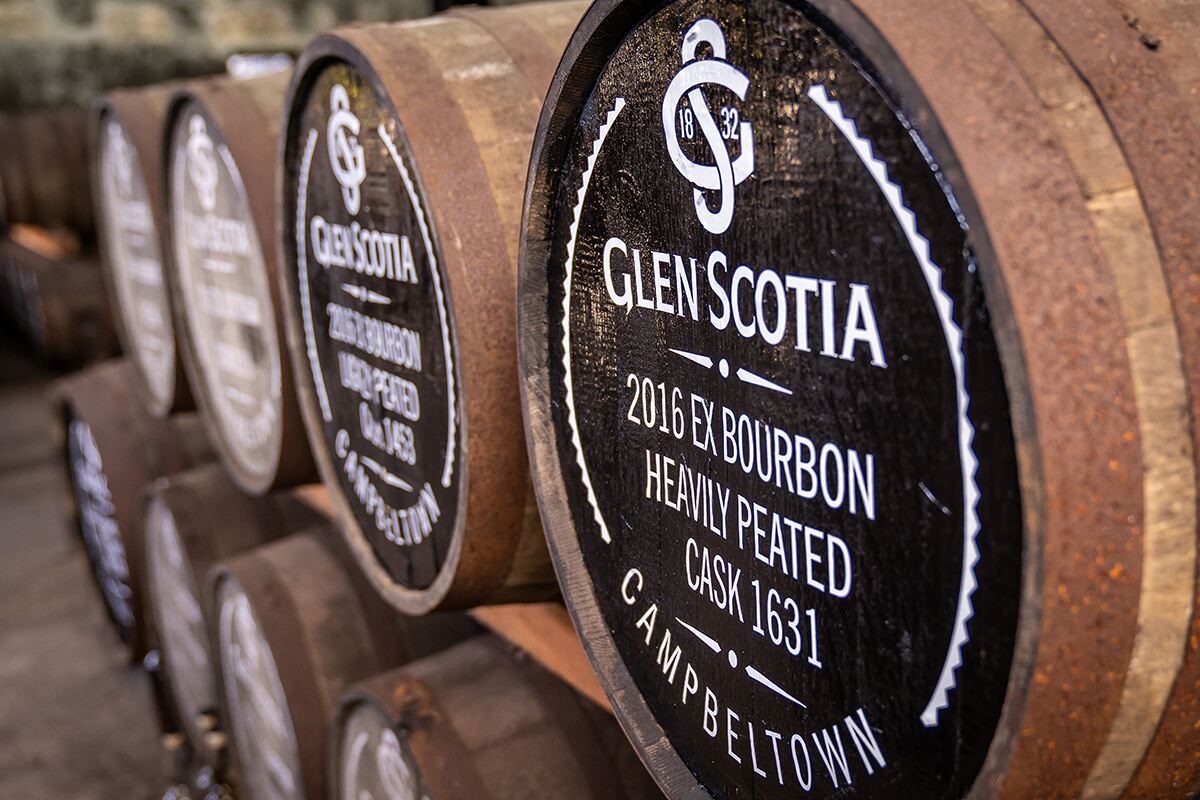
A useful way to choose a whisky for golf is to match it to the kind of course one tends to play. Coastal distilleries produce whiskies with a maritime character. Glen Scotia in Campbeltown, Caol Ila on Islay, Old Pulteney in Wick. Salt on the air, a touch of brine, sometimes a note of damp seaweed. Anyone who has played links golf at Machrihanish or the Old Course in a stiff onshore wind will recognise the flavour. It tastes like the conditions one has just played in.
Parkland whiskies, if such a category can be said to exist, lean elsewhere. Loch Lomond’s single grain, unpeated, has an elegant floral note. Glenmorangie’s Tale of the Forest carries birch bark and heather blossom. Glenkinchy from East Lothian, the only lowland distillery within easy reach of Edinburgh’s golf belt, is light and grassy. These are whiskies that suit the strolling rhythm of a parkland round, the long tree-lined eighteenth at Gleneagles or the autumn light coming through the elms at Sunningdale.
There is no rule about this. A Bowmore on a parkland course is perfectly acceptable. A Glenmorangie on a links is a fine choice. But the matching is part of the pleasure for golfers who think about these things, and Scotland has obliged by producing whiskies in nearly every flavour profile its courses might suggest.
A life inside the blending vats
Few people have lived as closely to the intersection of whisky and golf as Gordon Bell. Forty years in the Scotch whisky industry, beginning as a young man at William Muir and Bond on Commercial Street in Leith, in the days when stirring vats of whisky was done with giant wooden paddles and rolling casks could crush a foot in the era before steel toecaps.
Leith in the 1970s was a whisky town. McDonald and Muir, Vat 69, Crawford’s, McKinley’s, Old Parr, all operating within walking distance of the Links where, in the seventeenth century, the first written rules of golf had been drawn up. The connection between whisky and golf was geographic before it was cultural. Whisky was made where golf was played.
Bell went on to join the Distillers Company Limited, the DCL, and was involved in the development and launch of Johnnie Walker Blue Label. The trade press at the time confidently declared that nobody would ever pay more than a hundred pounds for a bottle of Scotch. They were wrong by several orders of magnitude. Bell later became part of the Johnnie Walker mentor programme for the American market, travelling between Boston, New York, Washington, Dallas, San Francisco and Los Angeles to introduce a new generation of American drinkers to Scotch whisky and the story of Scotland behind it.
His favourite venue, by some distance, was the Playboy Mansion in Los Angeles, where 300 guests at a time would listen to a Scotsman explain how blending worked. The programme was effective beyond all expectation. Sales of Johnnie Walker Black rose by 30 to 50 per cent in the cities Bell visited, in what was otherwise a flat market. The lesson he took from it, and the lesson worth taking, is that the story behind the product matters as much as the product itself. Golf knows this too. The bag your grandad used, the course your uncle introduced you to, the sweater you wore for your first medal: the things we keep are the things that have stories attached.
The Real McCoy and a French beetle
Two unlikely events in the late nineteenth and early twentieth centuries shaped the global market for Scotch whisky, and golf was never far behind.
The first was Phylloxera, a vine louse that arrived in France in the 1860s and proceeded to wipe out much of the European wine and brandy industry over the following thirty years. Brandy and cognac had been the fashionable drinks of the day in Britain and across the Empire. Their sudden unavailability created a vacuum. Scotch whisky, which until then had been largely a regional product, stepped in to fill it. The timing coincided with the rise of the great blending houses, Johnnie Walker among them, who realised that combining whiskies from different distilleries produced something more consistent and more accessible than any single malt. Consistency was the key. The blend could be reproduced. The brand could be built.
The second was American Prohibition, from 1920 to 1933. The legal sale of alcohol was banned across the United States, but demand did not disappear. Captain William McCoy, a former Florida boat-builder, became the most famous of the rum-runners operating between the Bahamas and the American East Coast. McCoy’s distinction was honesty. While many smugglers diluted their cargo with industrial alcohol, McCoy never adulterated his. His Scotch was Scotch, his rum was rum, and his customers knew it. The phrase “the real McCoy” entered American English as a synonym for the genuine article. Among his cargo was a substantial quantity of Scotch whisky, and by the time Prohibition ended, Americans had developed a sustained taste for the spirit. The export market boomed.
Golf, expanding rapidly in America through the same period, was never far behind. The two crossed the Atlantic together, and the relationship between Scottish whisky, Scottish golf and American consumers has not loosened since.
Distillery trails worth a detour
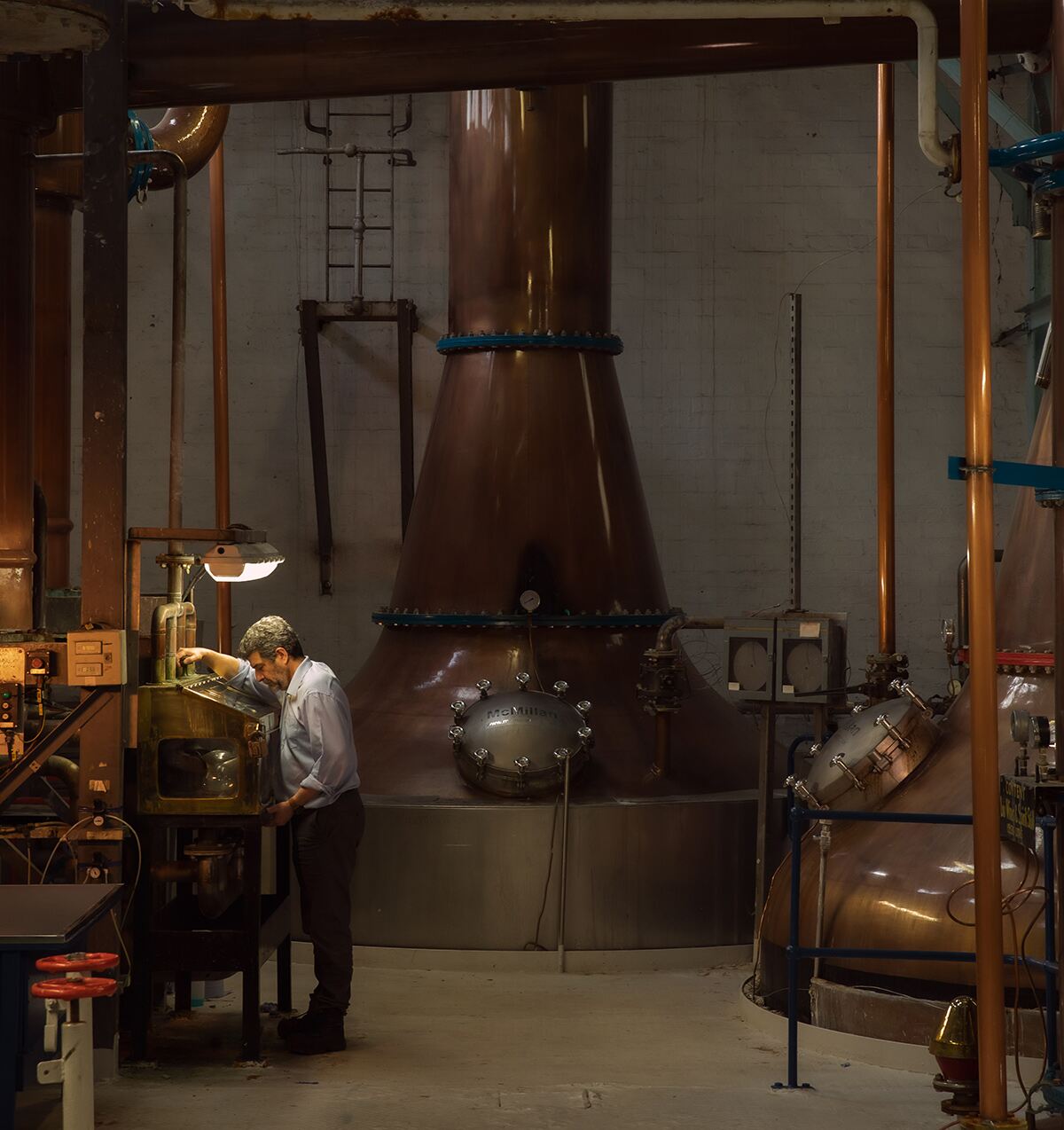
Visiting golfers, in the past decade, have become noticeably more interested in spending time off the course as well as on it. Golf tour operators report that distillery visits are now among the most popular additions to a Scotland itinerary, particularly since the pandemic shifted how people think about travel. The geography of the country makes this easy. The whisky regions and the golf regions overlap, in places almost completely.
In Fife, Lindores Abbey sits just outside Newburgh, less than an hour from St Andrews. Tradition holds that this is where Friar John Cor produced his 1494 aqua vitae, and the abbey has reopened in recent years as a working distillery. A morning on the Old Course followed by an afternoon at Lindores is among the more historically rich days a golfer can have in Scotland. Eden Mill, closer to St Andrews itself, produces craft gin and whisky, and the broader St Andrews drinks scene has been developing in interesting directions, with the St Andrews Brewing Company building a reputation alongside the craft beer movement.
In Aberdeenshire, the corridor running from GlenDronach through Speyside into the Highlands traces a route dotted with both distilleries and golf courses. Cruden Bay in the morning, GlenDronach in the afternoon, a memorable combination. Royal Aberdeen, Trump International Scotland and Murcar are all within easy reach. The Speyside whiskies, Glenfiddich, Glenlivet, The Macallan, Aberlour, GlenAllachie, are clustered for visits in a way that rewards a few days of slow driving.
In 1969, Glenfiddich became the first distillery in Scotland to open its doors to visitors. The wider industry thought it was a peculiar idea, even a daft one. Glenfiddich went on to become the world’s best-selling single malt. Distillery tourism is now a significant part of Scotland’s economy, and it dovetails with golf tourism in a way that benefits both sectors.
Further north, the Inverness corridor offers another fine pairing. Royal Dornoch and Castle Stuart sit close to Dalmore, Glenmorangie and the Tomatin distillery. The drive between any two of them is among the most scenic any visitor could ask for.
A jigger from St Andrews
A particular nostalgia attaches to old golf equipment. Many golfers started young with borrowed clubs, an old sweater from a grandparent, perhaps a putter handed down through three generations. The smell of polished wood, the slightly worn leather grip, the heft of a club that has known thousands of shots: these things matter in ways that are difficult to articulate.
A favourite at Glenmuir is a vintage jigger made by D. Anderson and Son in St Andrews. The jigger, a low-lofted utility iron from the hickory era, is easy to hit and gives a wonderfully soft loft on a chip and run. The polished wood of the shaft and the leather grip are the kind of details that connect a modern golfer to a longer tradition. They also, by happy coincidence, share a flavour profile with certain whiskies.
The wood and leather notes that mark out older Scotch are typically a sign of bourbon-cask maturation, where American oak gives spice and a warm richness reminiscent of Christmas cake. Loch Lomond 18 carries these notes well. So does Yamazaki 18, the Japanese single malt that has spent its years in American oak and Spanish sherry casks. The iconic Glen Scotia 1991, increasingly rare on the open market, is another example. The whisky and the equipment age in similar ways: slowly, in the dark, taking on character that no amount of marketing can replicate.
The best dram is the one in your hand
The answer to “what is the best whisky for golf?” is the kind of question that has no proper answer. Personal taste matters more than any guide. The best dram is the one in your hand, and the second best is the one in your friend’s flask offered at the ninth tee on a cold morning.
What the question really invites is a journey. Scotch whisky has roughly eight broad flavour profiles and several hundred distinct expressions. A golfer who plays for forty years and tries a different Scotch every other round will not exhaust the range. The same is broadly true of Scottish golf: dozens of links, hundreds of courses, lifetimes of weather and condition variations. Both are open invitations rather than closed problems.
The hip flask is a small theatre that connects modern golf to its past. The 1494 monk at Lindores, the 1457 archers being kept from their practice by the lure of golf, the 1764 St Andrews course committee, the 1860 first Open at Prestwick, the 1969 Glenfiddich visitor centre, the 2007 Loch Lomond partnership with The Open. Each is a small mark on a longer line. Carrying a flask of Scotch on a Scottish round is a way of participating in that line, however briefly. The whisky in the flask was made by people who care about their craft. The course one is walking was shaped by people who cared about theirs. The connection is older than either golfer or distiller.
Haste ye back, as they say at the eighteenth.