 2026 Platinum
Table of Contents
- The short answer
- The Wentworth moment
- Nobody governs golf dress codes
- What clubs actually object to
- Hoodie, midlayer or quarter zip
- When each one earns its place
- The Glenmuir and Sunderland range
- Women’s hooded golf clothing
The short answer
A technical golf hoodie, cut close to the body in performance fabric with a full zip and discreet branding, passes without comment at the large majority of UK courses. A baggy cotton sweatshirt does not. Clubs restrict the look rather than the garment type, and the distinction is one of cut, fabric and finish rather than the presence of a hood. We at Glenmuir also prefer no drawstrings, it gets in your eye line when putting and gives off a scruffy appearance. We instead ensure our hood necks have enough stretch in them to be comfortable to put on over your head and protect.
Traditional members’ clubs apply more scrutiny, and the hood itself is usually the point of contention rather than the garment. Some ask that it stays down and a collar shows. A small number extend restrictions to the clubhouse while permitting the same piece on the course. Since dress codes are set locally, a call to the pro shop before a guest day settles the matter in under a minute.
The Wentworth moment
The modern debate has a precise start date. Between 8 and 11 October 2020, Tyrrell Hatton won the BMW PGA Championship on the West Course at Wentworth, finishing 19 under par, and wore an Adidas hoodie on all four days.
The reaction was disproportionate to the garment. The hoodie trended on social media through the weekend, the manufacturer sold out its initial run within days, and several English clubs wrote to members restating that hooded tops were not permitted. One club’s circular compared them to designer ripped jeans, which tells you rather more about the club than about the hoodie.
Hatton’s own view, given the following year, was that the reaction put people off the game. He also made the more practical point that most of his critics had never swung a club in one.
Five years on, the argument has largely resolved itself. Hoodies sit on the rails of most pro shops in Britain, and the clubs that hold the line are the exception rather than the rule.
Nobody governs golf dress codes
This is the part most golfers get wrong, and it explains the confusion. The R&A does not set dress codes for golf clubs. Neither does England Golf, Scottish Golf, or any other body.
Dress codes are written and enforced club by club, by individual committees, with no reference to any national standard. That is why a garment can be entirely unremarkable at one course and refused at another eleven miles away, and why nobody can give you a definitive national answer to the hoodie question. There isn’t one to give.
What the R&A does do is license apparel, and this is where the question becomes easier to settle. Glenmuir holds an Official Licensee position for The Open, and the licensed range includes a hooded performance midlayer carrying the Claret Jug. A hood on an officially licensed garment for golf’s oldest championship is about as clear a signal as the game gives.

What clubs actually object to
Working through the complaints, three things recur, and none of them is the hood.
Bulk. A garment cut for streetwear bunches at the top of the backswing and hangs loose at the hem. It reads as borrowed rather than chosen, and that is what the committee notices from the clubhouse window.
Fabric. Heavy cotton jersey looks casual, holds water and dries slowly. Performance fabric with a brushed backing reads as sports clothing because it is.
Branding. A large logo across the chest is the fastest route to a conversation with the starter. A small crest on the sleeve is invisible.
Get those three right and the hood becomes a non-issue at all but the most traditional venues.
There is one exception that proves the rule, and it is worth stating plainly. No golf club in Britain objects to the hood on a waterproof jacket. A hood keeping rain off a player’s neck on the twelfth is understood as equipment. The same hood on a fleece in dry weather is read as a style choice, and it is the style choice that committees have opinions about. Once a golfer understands that distinction, the whole dress code question becomes considerably simpler.
Hoodie, midlayer or quarter zip
A golf hoodie is hooded and usually full zip, sitting at the relaxed end of the wardrobe. It suits practice rounds, junior golf, range sessions and cold starts.
A golf midlayer drops the hood in favour of a brushed-back fleece or technical knit, built to sit under a waterproof without adding bulk at the shoulders. It is what most clubs expect to see and it never generates a conversation.
A quarter zip is the most traditional shape in golf and the one rarely queried anywhere, including at the clubs most likely to raise an eyebrow at everything else. For a golfer building a wardrobe across several venues, or playing somewhere unfamiliar, it removes all guesswork.
The practical rule holds across all three: if the club is known and relaxed, the hoodie earns its place. If it is unknown or traditional, the quarter zip is the answer.
 |
 |
When each one earns its place
Consider a 7.40am tee time in late October, frost still on the fairway and the greens staff holding play while it lifts. That is where a hooded midlayer justifies itself: on over a polo before the round, under a waterproof if the sky turns, and packed away in the bag by the eighth once the sun is properly up.
Early and late season golf rarely holds one temperature for eighteen holes, which is why the system matters more than any single garment. A layer worn on the range before a lesson does a different job from one worn mid-round, where it has to come on and off without disturbing tucked-in kit or a glove already on the hand.
Fabric does the work. Brushed-back backing traps warmth without weight, a water-repellent finish handles drizzle without committing to a full waterproof, and stretch through the back and shoulders means the layer moves through the swing rather than resisting it. Cotton alone manages none of the three.
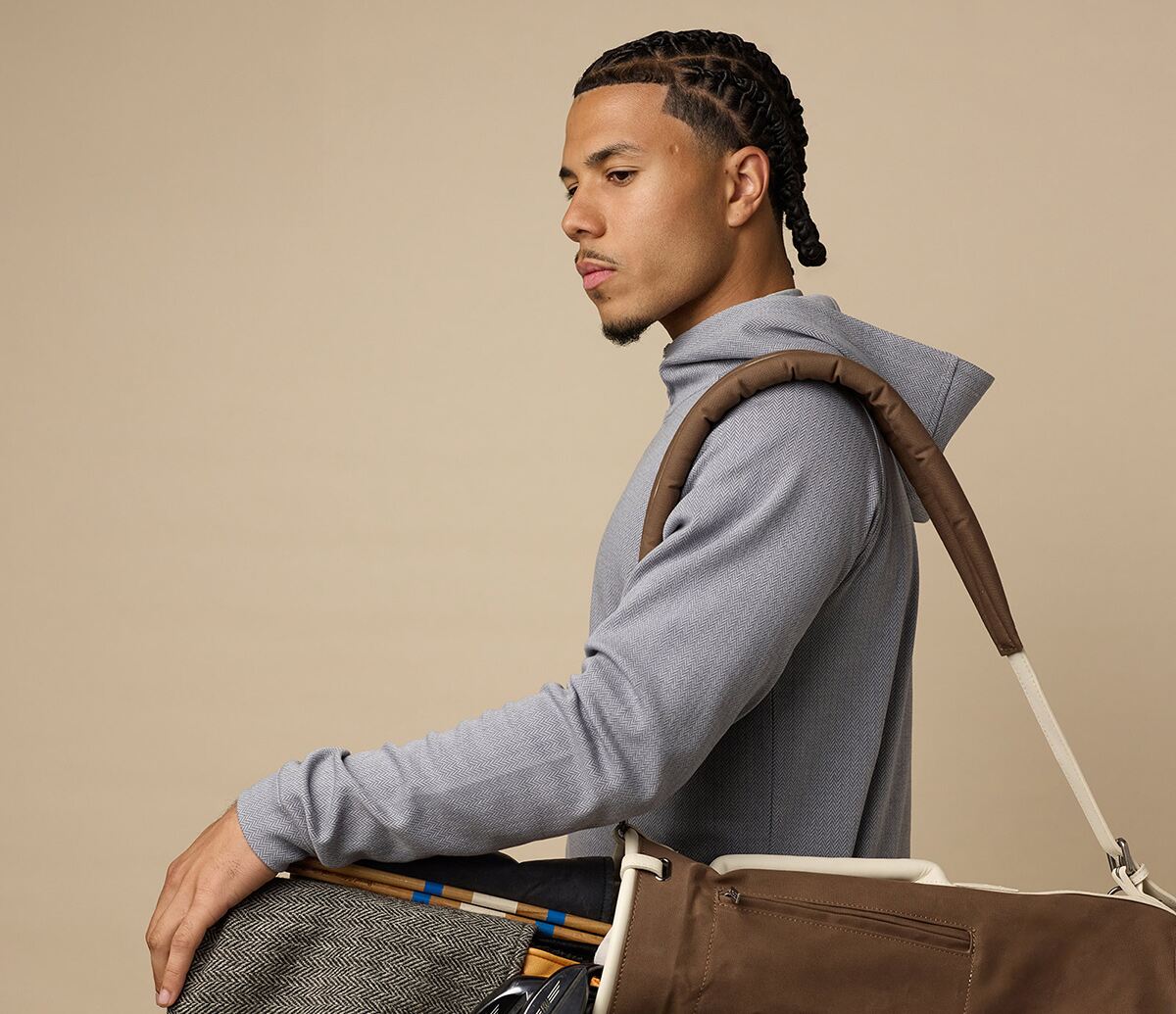
The Glenmuir and Sunderland range
Glenmuir’s hooded pieces sit across two categories on the site. Hooded outerwear and midlayers covers the performance end. Hooded knitwear covers the softer, clubhouse-facing shapes.
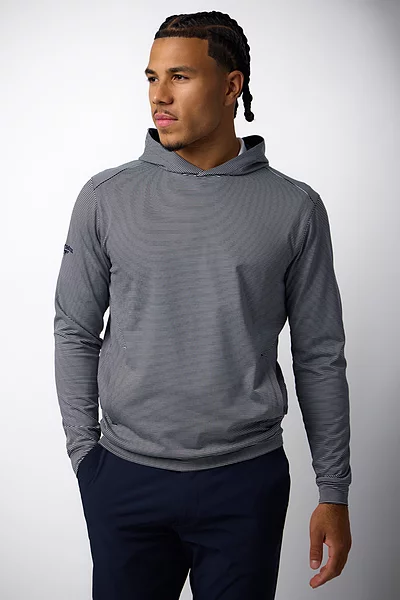
g.Cameron is the hooded performance midlayer and the piece most golfers should start with. Performance fabric with a brushed backing for thermal protection, a lightweight mesh-lined hood and pockets so it breathes rather than trapping heat, and a PFC-free Teflon EcoElite water-repellent finish for light showers. The Glenmuir 1891 embroidery sits in self colour on the right sleeve rather than across the chest, which is precisely the detail that keeps it on the right side of a dress code. There is also a Saltire version, and an officially licensed version in The Open collection with the Claret Jug embroidered by hand in Lanark.
g.Crossford takes the shape somewhere different. Saddle-sleeve construction for ease of arm movement and a touch of cashmere in the blend, cut to read as considered rather than sporty. It is the piece for a golfer who wants a hoodie that works over coffee as well as on the back nine, and it clears clubhouse dress codes that a fleece hoodie would not.
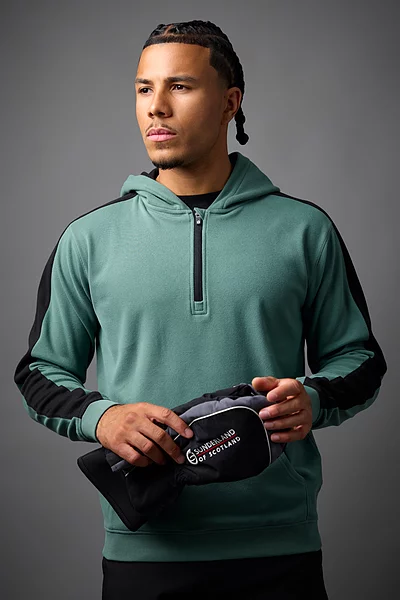
For the performance end, Sunderland of Scotland offers two. s.Atlas is built from a peached brushed interlock thermal fleece with four-way stretch, a low-profile lock-down contrast zip and thermal rib cuffs and hem. The fabric is engineered to run quiet, which matters more than golfers expect over eighteen holes. s.Everest adds a colour-blocked showerproof hybrid padded construction for the rounds where the forecast will not commit.
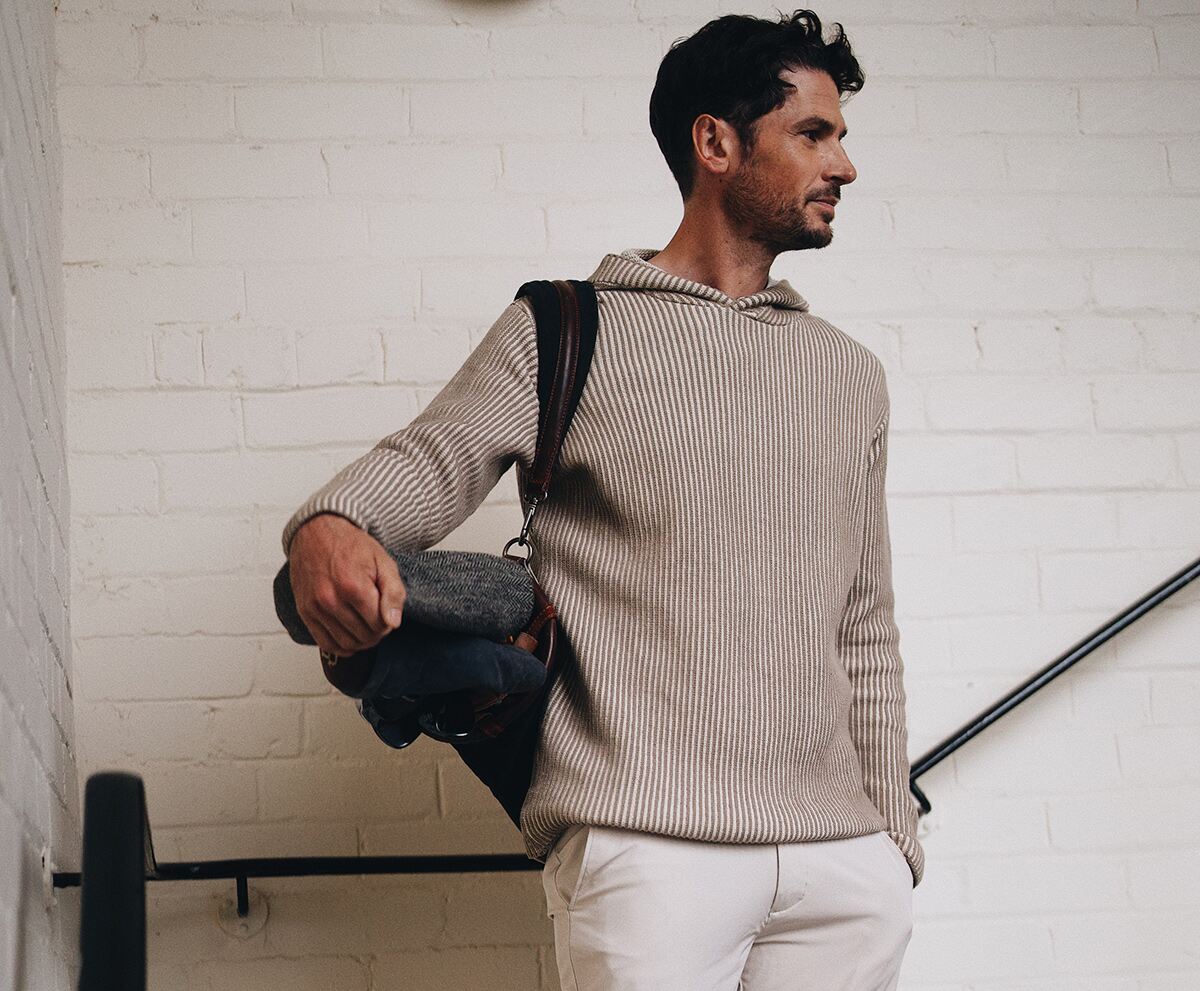
Glenmuir cuts a golf hoodie differently from streetwear from the first pattern. The hood has to sit flat under a cap, the body must not bunch at the top of the backswing, and the hem needs to stay put when a player bends to a low ball.
For anyone who would rather sidestep the question, g.Wick and g.Culross cover the same temperature range in a quarter zip with nothing to debate.

Women’s hooded golf clothing
The dress code position for women is identical, and so is the distinction between a hood worn for style and a hood worn for weather.
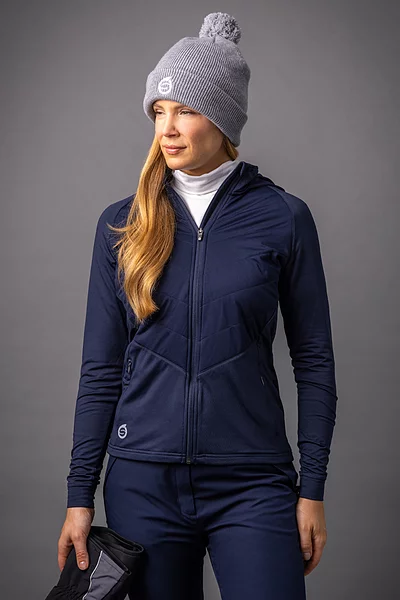
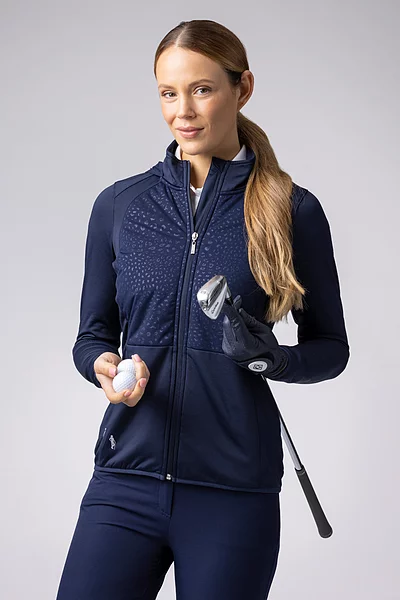
g.Ella is the full zip hooded performance jacket, with padded zones front and back, shaped seam detail and an embossed animal print that gives it presence without a logo doing the work. Invisible side pockets, stretch binding at hem and cuffs, a silver diamante zip puller, and a PFC-free water-repellent finish over Glenmuir’s Storm Bloc protection. It reads as outerwear rather than leisurewear, which is what clears a dress code.
s.Sarenne from Sunderland of Scotland is the hybrid hooded quilted thermal jacket, built for the colder end of the season where a midlayer alone stops being enough.
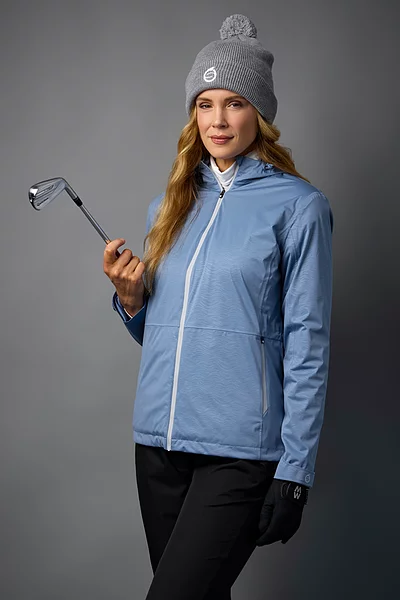
s.Whisperdry Whistler is a fleece-lined waterproof rather than a hoodie, and it belongs in this conversation for a different reason: it is the hooded garment nobody has ever questioned. When rain arrives, the hood stops being a style decision.
For a hood-free alternative across the same temperature range, g.Carina is the shaped quarter zip performance midlayer, cut through the waist rather than scaled down from a men’s block.