 2026 Platinum
Table of Contents
- Arnold Palmer: the original golf style icon
- Gary Player: black on black on black
- Tiger Woods: the one that changed everything
- Seve Ballesteros: passion personified
- John Daly: against the grain
- A closing thought
Look at how golf fashion shows up on social media right now and you’ll notice something. The performance-orientated, slim-fitting, corporate-sponsor look that defined the last decade is on its way out. Instead, what’s coming back is older, louder, and a lot more interesting. Abstract designs, baggy pleats, heavier materials with a drape you can’t get out of a performance fabric.
This isn’t a nostalgia trend. It’s a generation realising that golf used to have personality, and that the players who shaped this game weren’t just athletes, they were characters with wardrobes you could instantly recognise. I’ve picked five of them. I’ve left out a few of the names you’d expect to see in a piece like this, because if you want to understand how golf got its style back, you have to look at the players who broke the mould, not the ones who upheld it.
Arnold Palmer: the original golf style icon
Every conversation about golf style starts with Arnie, and it should. The King pioneered golf style in the 1950s and 60s like no one before him. As the game reached a wider audience, Palmer was among the first to recognise that how you carried yourself, and how you looked, became part of the spectacle.
Knitwear played a central role in Palmer’s on-course style. Layered turtlenecks, cashmere v-necks, cable-knit cardigans. The cardigan in particular became something close to a signature, a piece he’d pull on and off through a round depending on the weather and the moment. His early Open appearances captured this approach: simple colour combinations, clean styling, the kind of knitwear-led look that feels just as relevant now as it did then.
There was a rhythm to the way Palmer dressed. Polos one day, mock necks the next, small changes that shifted the mood without ever drawing attention. Around that, everything remained controlled. Muted toned and restrained patterns, a style built on consistency.
Palmer built a look that remains iconic sixty years later, and the reason is simple. He wasn’t trying to look a certain way. He was just dressing like himself. That’s the lesson, and it’s the one every player on this list, in their own way, also learned. Palmer was the one to set the blueprint.
Get the look. Pair g.ROSS linen lightweight golf trousers with a three-button g.DEACON polo in Ascot blue. Layer with a cashmere or cotton-cashmere v-neck for the classic Palmer silhouette.
Gary Player: black on black on black
Gary Player is the golfer social media would have loved if the internet had been around in 1965. He showed up to majors in black head to toe, decade after decade, while everyone else was wearing pleats and pastel knits. He turned a colour into a brand forty years before anyone else in the game caught on.
The origin story is better than most people realise. In his own words, when Player left South Africa to turn pro, his father, an uneducated man supporting a large family but the kind of man who spoke three languages and figured things out, told him: “if you’re going to be a pro, you need to have a brand.” Player had no idea what he meant. Then he got to America, watched an episode of Have Gun, Will Travel, saw Paladin in his black outfit with the silver holsters, and decided that was him.
The lesson holds up. The most stylish people in any era, golf or otherwise, aren’t the ones chasing trends. They’re the ones who figure out their thing early and refine it for the rest of their career. Player was one of the first golfers to understand this, and he did it before personal branding was a phrase anyone used.
Get the look. The Player formula remains the same. Black trousers, black polo, black knitwear. Glenmuir’s g.ROSS, g.TAIN and g.KNOX in black colourways will see you through.
Tiger Woods: the one that changed everything
For a generation of golfers, there is no separating golf style from Tiger. He isn’t a chapter in the story. He is the story. Everything that’s happened in vintage golf over the last few years, every archive piece going for ten times what it cost new, every shift in how the sport gets photographed and styled and sold, all of it traces back to a stretch of roughly fifteen years where Tiger dominated the fairways in outfits so sharp he made everyone else look dressed wrong.
The mock neck is the detail people underestimate. Soft-collar polos had been the uniform for fifty years. In the early 2000s, Tiger showed up in something sharper, closer to a street look than the traditional aesthetic golf was used to. The Sunday red did the same thing in colour form. While the rest of the field hedged with navy and white and the safe palette of a sponsor catalogue, Tiger wore the loudest possible colour on the most important day of the week, every week, for twenty years. That isn’t a marketing campaign. That’s a young player who decided what he wanted to look like and never wavered.
What gets lost in the conversation about Tiger’s wins is how much of his presence was aesthetic. The walk, the fist pump, the swoosh. He didn’t dress like a golfer. He looked like he’d been built by a different industry, somewhere between an athlete and a streetwear model, and dropped onto a course to embarrass the dress code.
The gear told the same story. The Titleist 975D driver. The Buick bag. The low tees. Equipment that in any other era would have just been equipment – but Tiger’s association, caused these to become something people now collect, frame, and instantly recognise as artefacts from one specific moment in sport. Equipment doesn’t usually do that. Tiger’s did.
Tiger gave golf a new visual language: the mock necks, the Sunday red, the gear, and even the way he carried himself. It’s through that, more than anything else, that he single-handedly built a new era of golf culture. One which will shape generations to come.
Get the look. A mock-neck base layer under a relaxed-fit polo, with a flash of red somewhere if you have it. The g.KELSO cotton roll neck nods to Tiger’s silhouette without imitating it.
Seve Ballesteros: passion personified
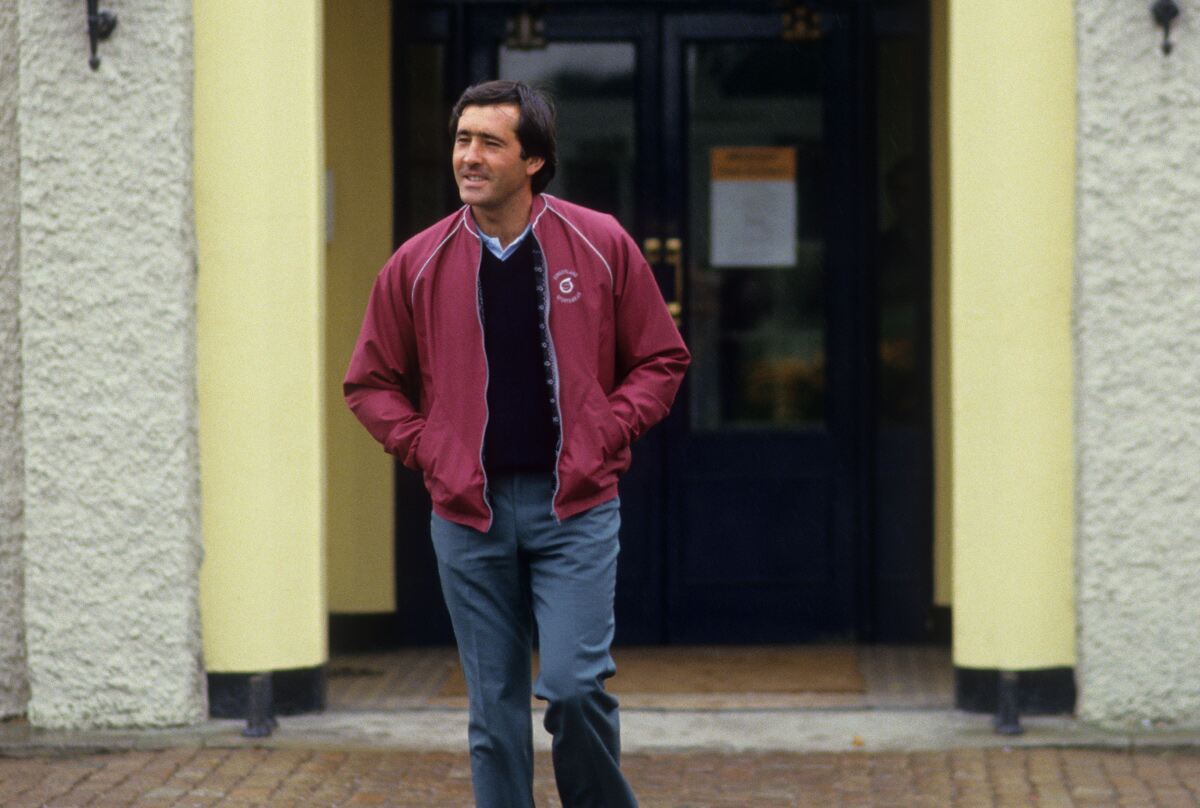
Seve had the most expressive game of his generation. Along with the raw emotion he poured out on the green, Seve wore one of golf’s most distinctive wardrobes.
To understand his style, you first have to understand who he was. Seve grew up in a fishing village in northern Spain, started caddying at eight, taught himself the game on the beach with a 3-iron his brother gave him. He arrived on tour as a complete outsider: working class, Spanish, self-taught, in a sport that had been run for decades by polite Englishmen and Americans in beige. He played like none of that bothered him. He won the Open at 22 at Royal Lytham and St Annes with a smile on his face. He drove a ball into a temporary car park at Lytham and got up and down for birdie like it was nothing. He cried on greens, hugged opponents, fist-pumped before fist-pumping became a thing, another quiet nod to Tiger. Every shot looked like it meant something personal.
The clothes were an extension of all that. Seve’s wardrobe had the same freedom his swing did. Loose, theatrical, completely unbothered by what the dress code thought it was supposed to look like. The bright knits weren’t a fashion choice in the way we’d talk about it now. They were a personality leaking through the fabric. He was the most expressive golfer of his generation and he dressed like one.
His trademark navy sweater was a final-round lucky staple, but Seve also wore bold colour-block combinations elsewhere. Red polo shirts, bright pink v-neck sweaters, pastel trousers. The same confidence he carried on his journey to becoming one of golf’s greats was there in the clothes too.
Ballesteros reminds us that style and emotion go hand in hand. What you wear on the course can reflect the passion and joy of playing the game.
Get the look. Combine dark trousers with a g.DEACON yellow polo and a g.WILKIE raspberry merino sweater for Seve-style colour blocking.
John Daly: against the grain
You can’t talk about golf style and pretend Daly didn’t exist. Before the American flag plaids, the neon trousers, and the patterns that looked like they were designed by someone in the middle of an argument, Daly’s look in the early 90s was already one of the most distinctive in the game.
In his breakout years, Daly showed up wearing loud colours, colour-blocked panels, and brave prints. The kind of patterns that people didn’t traditionally associate with a golf shirt. But for Daly, it worked. Baggy fitting, pleated trousers were the base. Cap pulled low over the mullet. Cigarette in one hand, Diet Coke in the other. He looked like he’d shown up to the wrong sport and decided to win it anyway. And then, more or less, did.
What’s underrated about Daly is how coherent his wardrobe was with his identity. The clothes, the swing (loose, violent, all or nothing), the way he played fast and refused to grind, the way he talked, the way he carried himself. All of it belonged together. It was a wardrobe that matched a man. There was no styling team behind it.
It wasn’t universally loved. Daly’s look offended the traditionalists and thrilled the rest, and the argument was never really resolved. It just got louder. What’s not in dispute is that the clothes were unmistakably him. Rebellious identity, in fabric form.
Get the look. Glenmuir doesn’t go full Daly. But for golfers wanting to bring some character back to the dress code, a printed polo, a stronger colour palette and trousers that aren’t navy is a credible start.
A closing thought
What ties these five together isn’t the wardrobe itself. It’s the reflection of identity inside it. Palmer’s restraint, Player’s discipline, Tiger’s reinvention, Seve’s freedom, Daly’s rebelliousness. Five entirely different visual identities, one shared instinct: a golfer who knows what they stand for and builds a look that reflects that. That’s the reason why these wardrobes are coming back. Through social media, a new generation of golfers are rediscovering that golf fashion was never just about the clothes. It was about the values, personality, and identity of the icons inside them. Not the outfit the sponsors put them in.
So, which one are you? Whose energy hits closest? And more importantly, which look do you want to reflect on the course?