 2026 Platinum
Table of Contents
- The course you can only play one week a year
- The story of Palmetto: 1892, train tracks and sandy soil
- The Augusta connection: 12 founders, MacKenzie and a famous complaint
- The architects’ lineage: Hitchcock to Hanse
- The clubhouse and the trophy room
- The Devereux Milburn pro-am: when the purse was bigger than the Masters
- The course itself: short, undulating, around the greens
- Hole-by-hole notes from a member’s perspective
- Famous visitors: from Vardon to Wodehouse
- The culture: not a country club, just golf
- Playing Palmetto during Masters week
- What to wear at Palmetto
The course you can only play one week a yearThere are perhaps only a handful of private golf clubs in the world that genuinely open their gates to visitors for one week a year. Palmetto Golf Club, in the historic town of Aiken in South Carolina, is one of them. The week the doors open is Masters week. And the reason is the same reason the club exists at all, sitting just over 20 miles from the gates of Augusta National. For the other 51 weeks of the year, Palmetto is reserved for its members and their guests. Around 300 of them, mostly local, with a small handful from overseas. The current green fee for visitors during Masters week is $195. A modest figure, perhaps, until you understand what you are paying to walk. The visitor revenue is not incidental. A member greeted us on the practice range and said, with no prompting, how grateful the club was that visitors come to play during Masters week. It helps maintain the course. It funded the new halfway house. It keeps the members’ annual dues down. That kind of warmth is uncommon at private clubs, and it sets the tone for a day at Palmetto. You are not tolerated. You are welcomed. For visitors planning their own Masters trip, see our companion piece: An Insider’s Guide to The Masters. |
The story of Palmetto: 1892, train tracks and sandy soil
Aiken is horse country first and golf country second. The town owes its existence to the Aiken Winter Colony, a community of wealthy Northeastern industrialists who began wintering in Aiken in the late 19th century, drawn south by the mild climate and the soft, sandy soil that made it ideal for training thoroughbred horses. The non-stop train service from New York brought owners, their families, their horses and their staff down for the winter season.
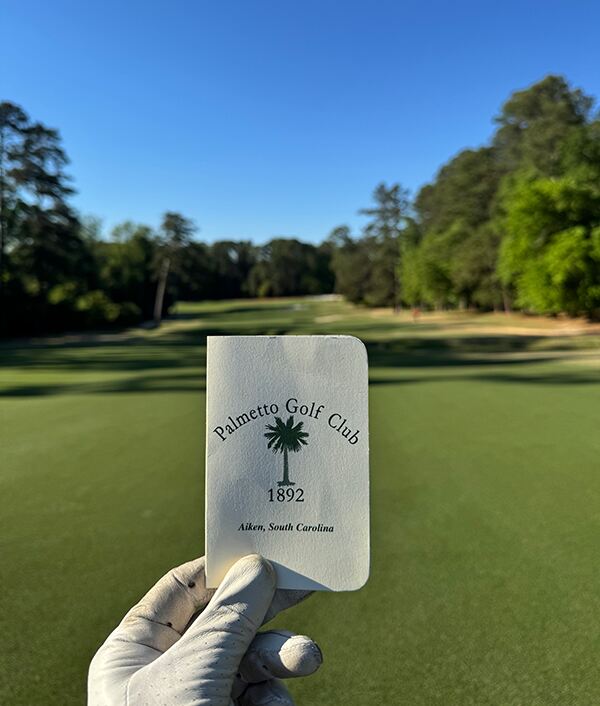
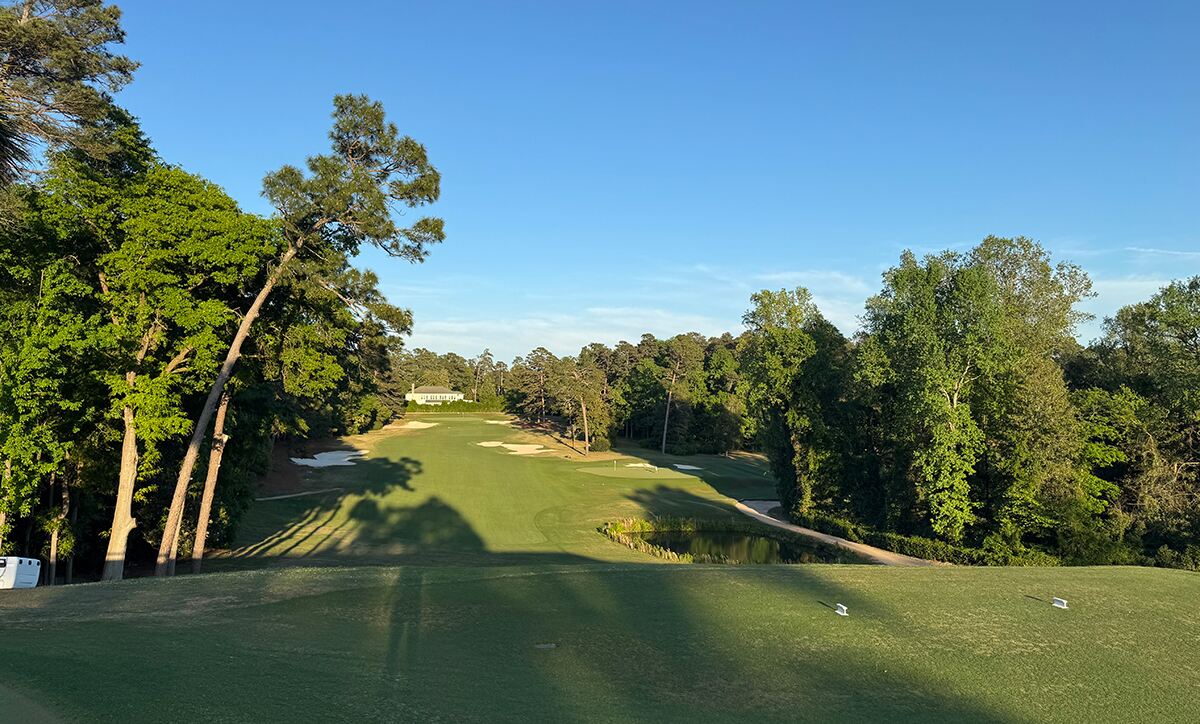
Two of those Northern winter visitors founded Palmetto Golf Club in 1892. Thomas Hitchcock, a prominent Long Island sportsman, and William C. Whitney, a wealthy industrialist who trained and raced horses, laid out the original four holes as another diversion for the Winter Colony alongside polo, fox hunting, steeplechase racing and tennis. The first four holes occupied the land where holes 16, 17, 18 and the practice range (can hit up to a 3 iron max) sit today. This explains why these four holes feel a little different to the rest of the course, and are a little more narrower and fiddly.
 |
 |
In 1901, Hitchcock and Whitney transferred title of the land and facilities to the Whitney Trustees, to ensure the club’s preservation for future generations. Palmetto has leased the land from the Whitney Trustees ever since, and recently signed a new lease through the year 2080. That kind of structural permanence is part of what makes Palmetto what it is.
A nod to the founders sits on every tee. The tee markers at Palmetto are pieces of railway track, cut to size and painted in the colour of the corresponding tee. A small but pointed reminder of the trains that brought the Hitchcocks and Whitneys south, and of the world they built when they arrived.
The Augusta connection: 12 founders, MacKenzie and a famous complaint
Palmetto’s history is intertwined with Augusta National’s in ways most golf fans never learn. According to Tom Moore, the pro emeritus at Palmetto who has been with the club for over 30 years, 12 of Augusta National’s founding members were also members of Palmetto. They wanted Augusta National to be built in Augusta specifically so they would be near Aiken. Without that Palmetto connection, Augusta National might have been built in Atlanta instead. That is a sentence with weight.
The connection runs deeper. In 1932, immediately after completing his work at Augusta National, Dr Alister MacKenzie was asked by Augusta members who also belonged to Palmetto to come and convert Palmetto’s sand greens to grass and lengthen the course. MacKenzie agreed. The same contractor who had built Augusta, Wendell Miller of New York, was engaged to do the work. Some leftover materials from the Augusta National project quietly made their way over to Aiken.
MacKenzie did the work too well. In an article quoting the architect, MacKenzie wrote: “The alterations at Palmetto have been such a success that the Chairman of Bobby Jones’ Executive Committee at the Augusta National writes me saying, ‘We have only one serious complaint against you regarding the Augusta National. The layout you designed at Aiken is liked so well that the Aiken colony does not seem to be the least bit interested in coming over to the Augusta National.’”
Bobby Jones himself later wrote a letter, still kept in the Palmetto clubhouse, asking the club to limit play for Augusta National members because so many were bypassing the home of the Masters to play in Aiken instead.
The architects’ lineage: Hitchcock to Hanse
Few American golf courses have a more thorough architectural pedigree than Palmetto. The lineage tells the story of American golf design itself.
1892: Thomas Hitchcock laid out the original four holes (now 16, 17, 18 and the practice range).
1895: Herbert Leeds, who designed Myopia Hunt Club near Boston, expanded Palmetto to a full 18 holes alongside Jimmy Mackrell, the club’s first golf professional. Myopia would go on to host four U.S. Opens by 1908.
1928: Donald Ross is recorded as having done some work at Palmetto, believed to include installing the early irrigation system by damming the creek down the hill from the 18th tee.
1932-1933: Alister MacKenzie, fresh off Augusta National, converted the sand greens to grass and lengthened the course from 5,833 yards to 6,370 yards. Wendell Miller managed the construction using the same crew that had built Augusta.
Late 1980s to 1995: Rees Jones designed bunker renovations, completed when the course was re-grassed in 1995.
2003: Tom Doak, a recognised authority on MacKenzie’s work, provided recommendations to restore some of the MacKenzie design characteristics.
2005-2007: Gil Hanse undertook a restoration project, working from 1938 aerial photographs unearthed from the National Geological Survey, alongside old member photographs. Hanse re-exposed sandy scrub areas and re-established the bunker shapes that had drifted from MacKenzie’s intent over the decades.
Hanse continues to serve as the club’s resident architect. His view of Palmetto is worth quoting: he has called it one of the unquestioned hidden gems in American golf.
The clubhouse and the trophy room
The clubhouse at Palmetto, completed in 1902, was designed by Stanford White, the celebrated New York architect who also designed the iconic clubhouse at Shinnecock Hills. Many early Palmetto members were also members at Shinnecock, and the architectural lineage between the two clubs is no coincidence.
The clubhouse itself is small, charming, and unmistakeably from another era. The Historic Aiken Foundation has designated Palmetto a place of historic significance.
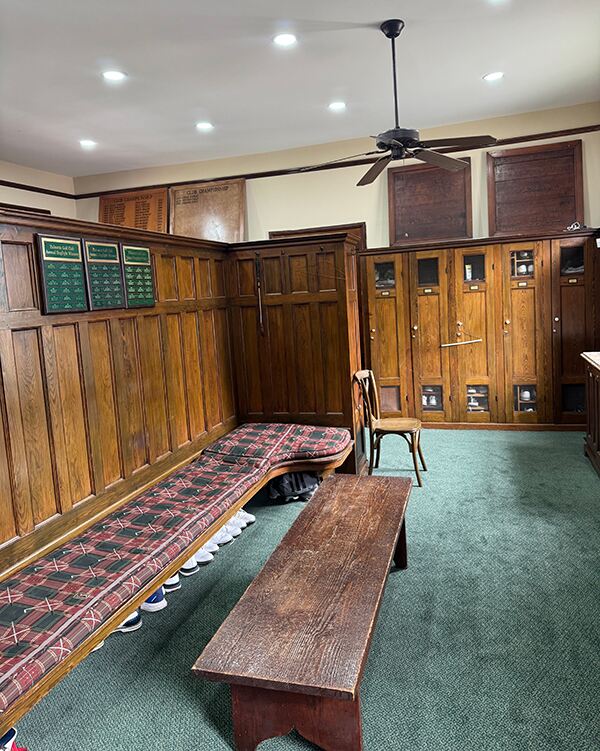
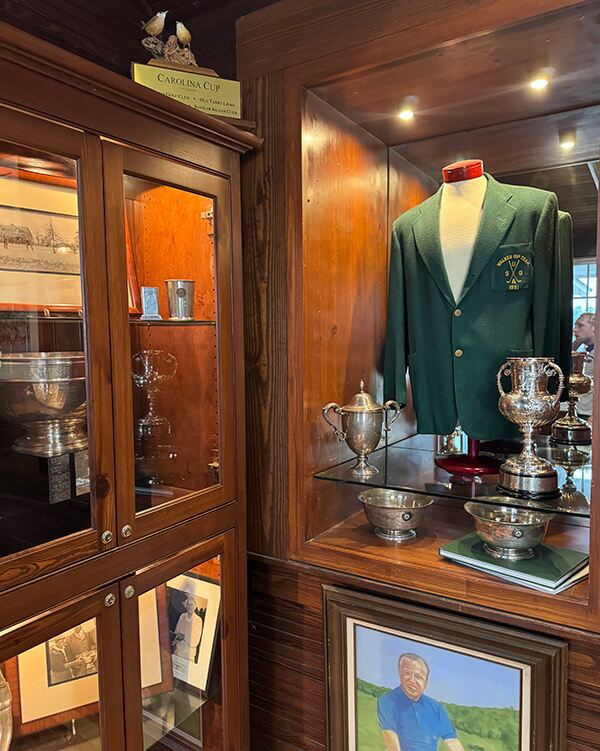
The pro shop, grill and trophy room sit in an even older and homier building next door. This is where Tom Moore keeps the club’s collection of memorabilia, including the oldest USGA membership certificate in existence, dated 22 January 1896. Palmetto was the 30th club to join the USGA. Palmetto would have been one of the original USGA members had it not been so far from the East Coast hubs.
The trophy room contains letters from Bobby Jones, Ben Hogan and George H.W. Bush, whose grandfather George Herbert Walker was an early member of Palmetto. It also contains the ball collection of Ralph Hutchison, the club’s first assistant pro who went on to become the announcer on the 18th green at the Masters, the U.S. Open and the PGA Championship. Hutchison collected balls from the players coming off the 18th. The collection includes balls from Hogan and Nelson, plus a Ryder Cup ball that Ben Hogan, a personal friend, gave him from the Cup he captained and won.
Even the Denver napkin from Augusta in the 1940s is preserved here, signed by Jimmy Demaret, Bob Jones, Gene Sarazen and others. Small treasures with enormous stories. Worth the visit alone.
 |
 |
The Devereux Milburn pro-am: when the purse was bigger than the Masters
From 1945 to 1953, Palmetto hosted the Devereux Milburn pro-am on the Tuesday of Masters week. It was, for those eight years, one of the most prestigious gatherings in American golf. The reason the world’s best players gathered at Palmetto on the Tuesday of Masters week is something modern golf fans struggle to believe.
The purse was bigger than the Masters.
Pros came to Aiken before Augusta because there was more money on the table. The roll of winners at Palmetto’s Devereux includes Ben Hogan, Byron Nelson, George Fazio, Henry Picard and Lawson Little. Ben Hogan and Byron Nelson were both regular visitors. The connection between Palmetto and the elite of American golf was already strong.
The tradition continues, in a slightly different form, with the modern Devereux Calcutta event held the weekend before Augusta. The big-money purses are gone, but the spirit endures.
The course itself: short, undulating, around the greens
Palmetto plays as a par 71, 6,695 yards from the championship tees, with a slope rating of 138. Most members play it at around 6,100 yards. Some members play it as a par 70, with the par-five 6th counted as a par four. By modern standards, it is a short course. It is also one of the toughest in South Carolina.
The defence is not length. The defence is the greens.
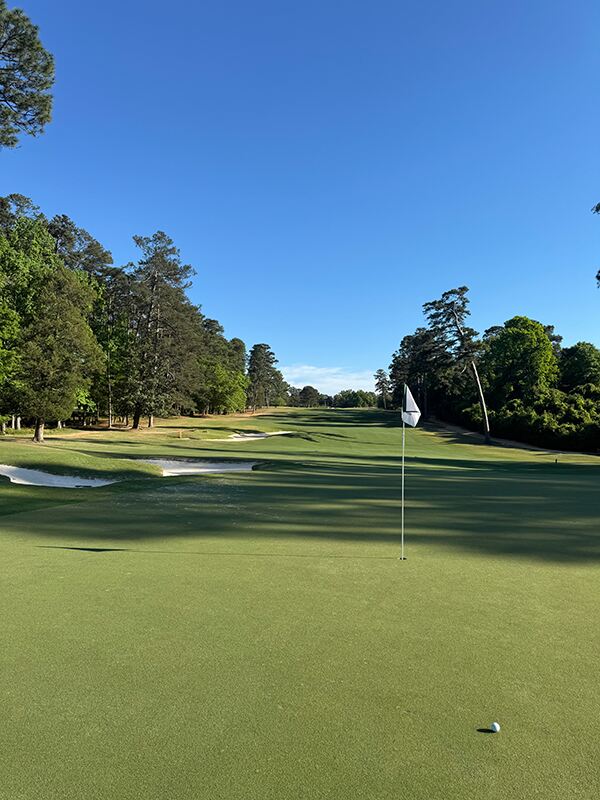
The greens at Palmetto are small, raised, fast and full of false fronts. The grass on the greens is Tiff Eagle, kept firm and fast. The fairways are Bermuda. Holding these greens with anything longer than a mid-iron is genuinely difficult. A long iron approach that lands on the front of the green will often roll back off the false front and leave a tricky chip. The shorter clubs, with proper spin, are what hold these greens.
A useful rule of thumb at Palmetto: keep the flag in front of you. Going long on most holes leaves a downhill putt or chip back to a green that will not hold. Coming up short of the pin and chipping or putting up the slope is almost always the safer option.
The wind and undulations are the other defining factors. Palmetto sits on classic Sandhills terrain, with constant elevation changes. Even a short approach can play wildly different lengths depending on the breeze and the slope. There are no flat lies. Aiken’s microclimate brings swirling wind through the pines that can make club selection a real puzzle.
The course was designed in 1892, before anyone imagined modern carry distances. The original bunkers sit around 260 to 280 yards out, easily carried by today’s longer hitters. That said, even when the bunkers are out of play, coming up short and leaving a full mid-iron is often the smarter play than smashing driver and leaving an awkward wedge from a downhill lie.
 |
 |
Hole-by-hole notes from a member’s perspective
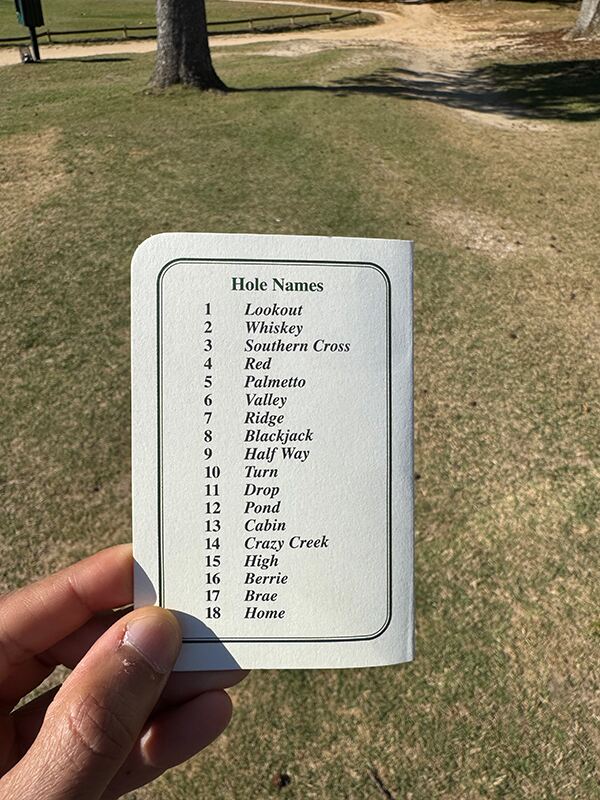
A few specific notes worth knowing for anyone fortunate enough to play:
Hole 1. Do not go above the hole. Middle of the green is fine. Anything pin-high or beyond leaves a putt that will not hold.
Holes 4 and 5. Be very careful on the tee shot. The fairway moves the ball significantly. On the 4th, the ball moves hard right. On the 5th, the ball moves left. Account for the kick before you commit to a line.
Hole 7. The first par three on the course, and the toughest. Bobby Jones called the 7th at Palmetto the best par three for medal play he had ever seen. The reason, as conveyed by Tom Moore, is that there is nowhere to miss. The green falls off on every side. Missing the green here means you will not make par or better most of the time.
Hole 9. Another testing par three. Like the 7th, the green falls off on every side.
Hole 11. A more forgiving par three than the 7th and 9th, but only by a margin. The tee shot plays sharply downhill, so club down 15 yards or so to account for the elevation drop.
Hole 12. The 12th green is famously fast. Local lore has it that Kevin Kisner, a Palmetto member who lives just off the 17th hole, would practise on the 12th green before Augusta National, because the speed translated. Whether or not the story is true in every detail, it tells you what to expect.
Hole 15. Do not go long. If the pin is back left, do not even try.
Hole 16. The toughest par three on the course. The green is raised about five feet from the fairway. Local college players say they hold this green perhaps one out of every six attempts. Take an extra club.
Holes 17 and 18. Short game and spin control are everything. The ball runs away from you on these greens. Be careful with the approach.
The defining truth at Palmetto is the same truth that defines Augusta. It is not how far you hit it that matters. It is where you put it.
Famous visitors: from Vardon to Wodehouse
Palmetto has welcomed an extraordinary cast of visitors over its 130-year history. Ben Hogan, Byron Nelson, Sam Snead, Ben Crenshaw, Dwight Eisenhower, William Howard Taft, George H.W. Bush, Bing Crosby, Fred Astaire and Barry Goldwater all made the trip to Aiken. Crenshaw, in particular, was famous for visiting Palmetto each April either before or after the Masters.
Two visitor stories are worth telling.
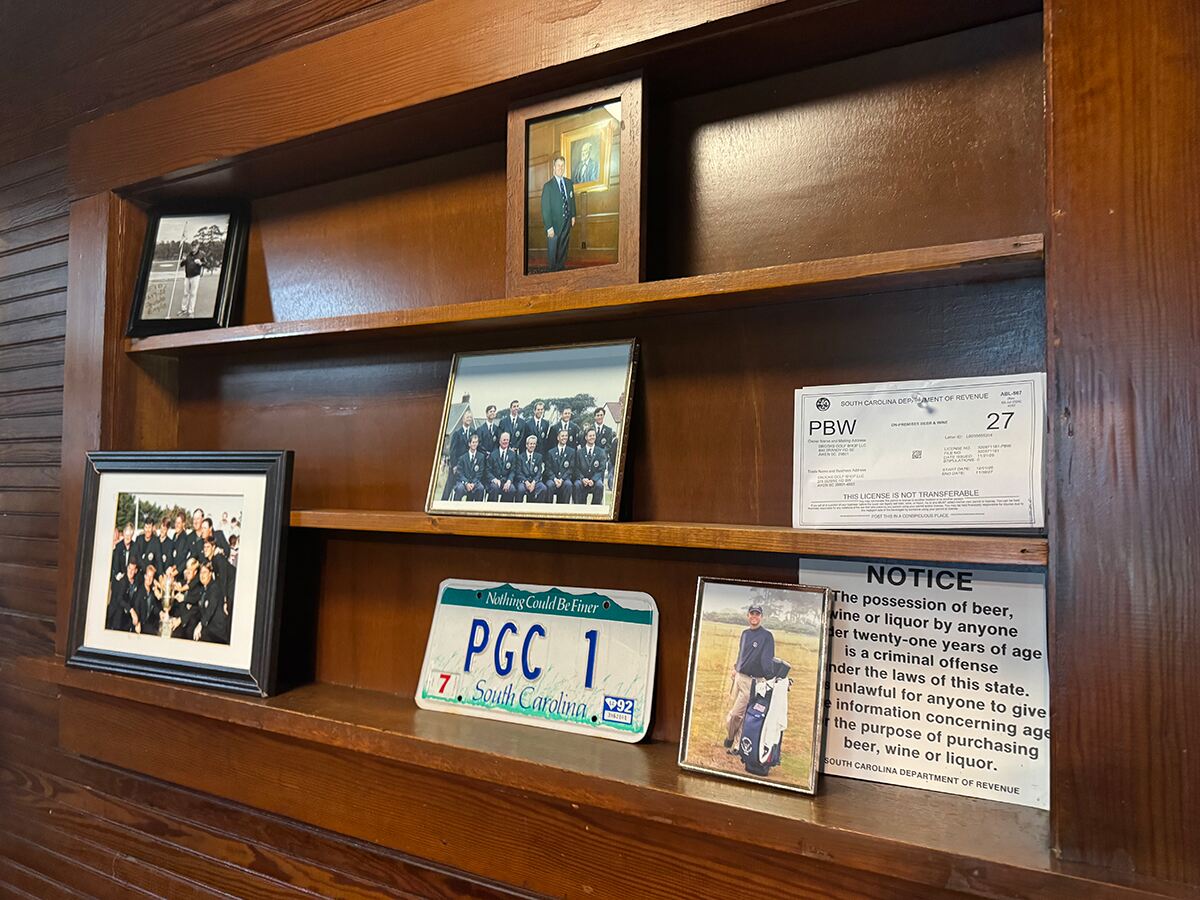
The first is Harry Vardon. The legendary British professional visited Palmetto in 1900 during his initial tour of America, the same year he won the U.S. Open at the Chicago Golf Club. As a professional, Vardon was denied access to the Palmetto clubhouse. He was not permitted to wear “plus fours” on the course. He was only allowed to smoke on the course by virtue of a special dispensation from the golf committee. A reminder of how class-bound the early game was, and how far it has come.
The second is President William Howard Taft. During one of his visits to Augusta, Taft called the Palmetto pro shop to arrange a round. The caddy master who took the call did not recognise the name. The exchange, as the story is told at Palmetto, went: “This is President Taft. I would like to see about playing Palmetto Golf Club tomorrow.” The caddy master replied: “We have no member by the name of Taft,” and hung up the phone. Whether the call was ever returned, history does not record.
Then there is P.G. Wodehouse, the Bard of the Links himself. Wodehouse famously won the only golf trophy of his life, a striped umbrella, at a tournament in Aiken, South Carolina. In his own words: “Hitting them squarely on the meat for once, I went through a field of some of the fattest retired businessmen in America like a devouring flame.” The tournament has long been believed to have been at Palmetto. The umbrella, sadly, has been lost to history.
The culture: not a country club, just golf
Palmetto is not a country club. It is, in a phrase used by members themselves, just golf.
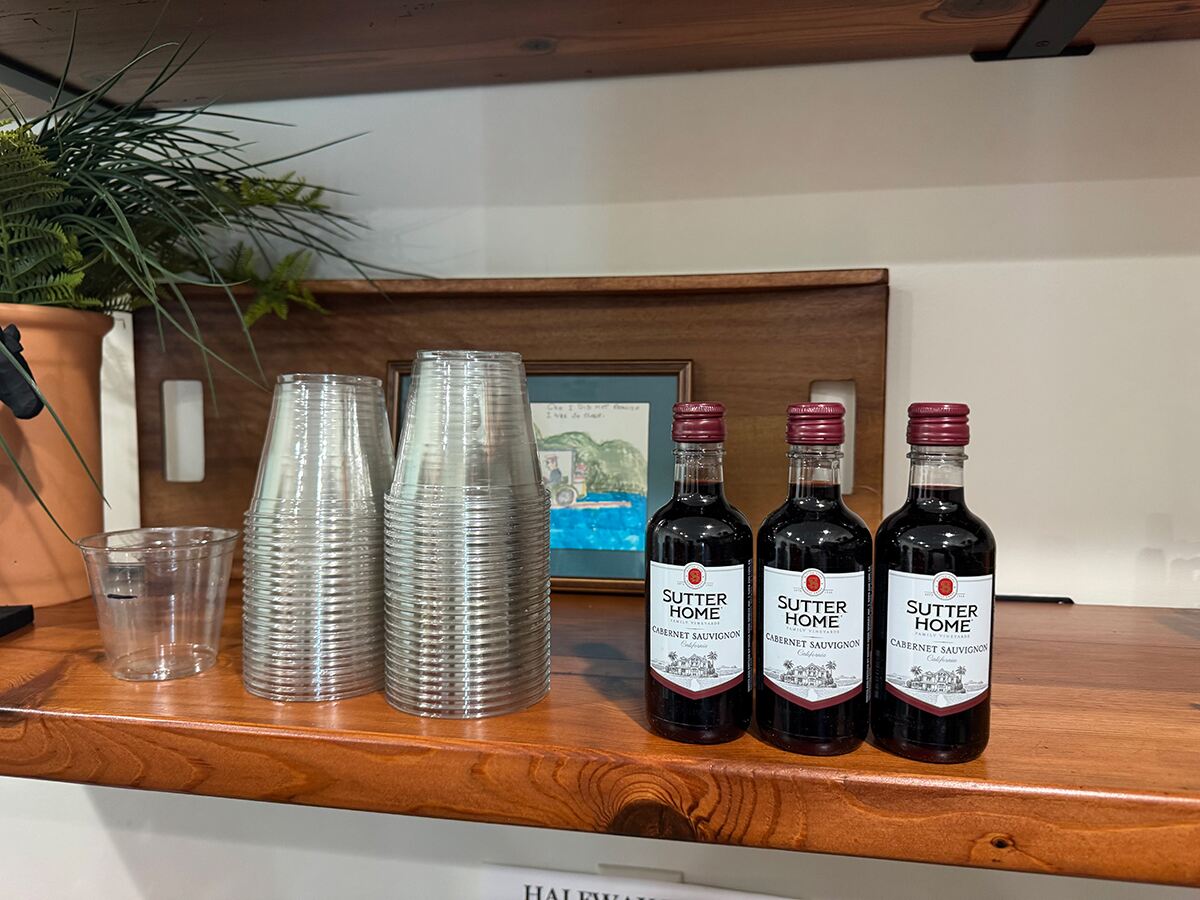
There is no formal bar service. There is no fancy dining room. The clubhouse does not serve cocktails to passing groups. What there is, instead, is a row of unlocked lockers in the men’s room, and inside each locker is a member’s personal supply of liquor. The honour system applies. You help yourself to your own bottle, and you trust that your bottle will still be there when you next return.
The course was, as Tom Moore put it, never meant to play 100 people a day. It was always exclusive. The membership today numbers around 300 locals, with a small handful from overseas. The pace is unhurried. The atmosphere is gentle. There is no tension at Palmetto. There is just golf.
That cultural restraint is part of what makes the club so special. Palmetto does not need to prove anything. It does not chase relevance. It has known exactly what it is for 130 years, and it sees no reason to change.
Playing Palmetto during Masters week
For visitors planning to combine The Masters with a round at Palmetto, a few practical notes.
The green fee during Masters week is currently $195. The club takes bookings directly. Tee times during this week book up well in advance, often months ahead, so plan your trip early. If you are flying into Augusta for The Masters and have a spare morning, the 20-mile drive to Aiken is well worth the early start.
A caddy is recommended on the first visit. Local knowledge is genuinely valuable at Palmetto. Knowing which side of the fairway to favour on the 4th, knowing not to go above the hole on the 1st, knowing where the false fronts will reject your approach, all of this is what separates an enjoyable round from a frustrating one. The Palmetto caddies have years of accumulated wisdom about the green complexes. Many are local playing students and are very good at golf and reading putts.
Do take time after the round to visit the trophy room. Tom Moore, if he is in, will happily talk you through the memorabilia. The 1896 USGA certificate alone is worth the visit. So is the Hutchison ball collection. So are the letters from Bobby Jones.
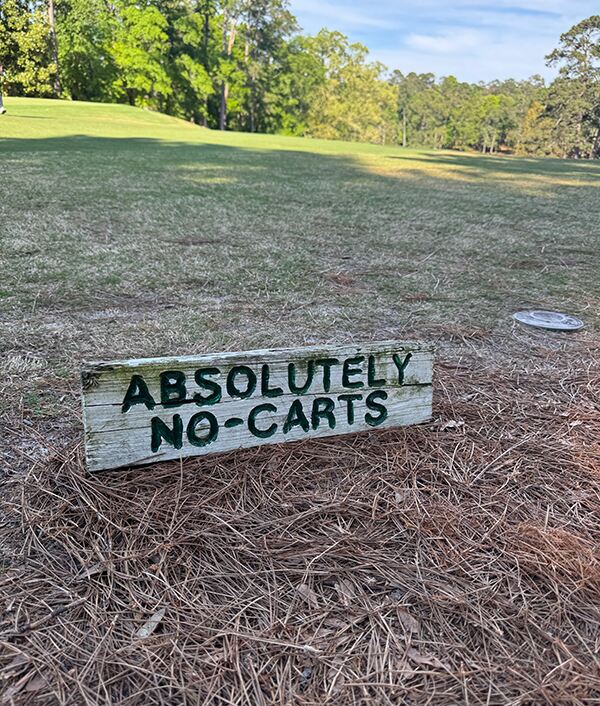
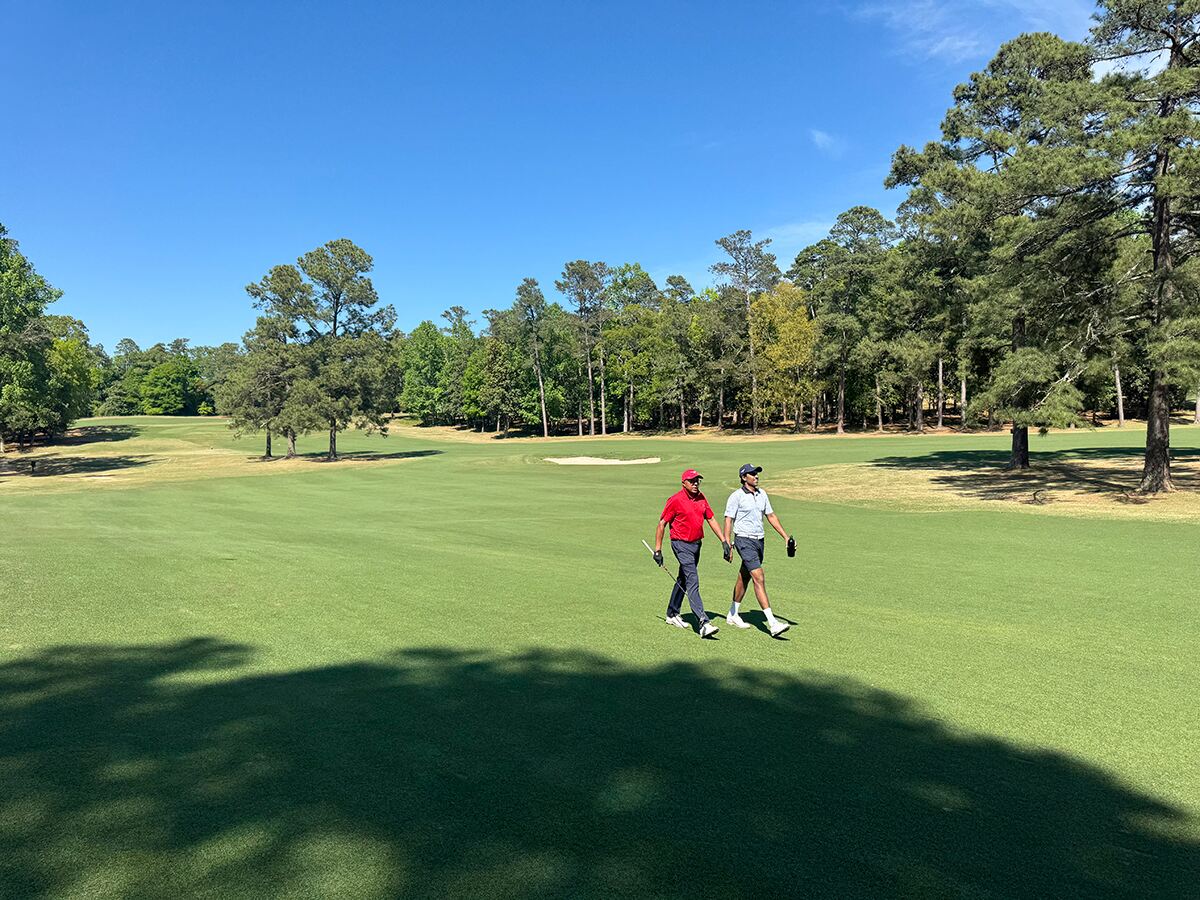
The course is walking-only. The pace will be brisk. Plan for around four and a half hours for 18 holes.
What to wear at Palmetto
Palmetto observes the dress code that any private American club of its vintage would expect. Smart-casual: a tailored polo, lightweight stretch trousers, soft-spiked shoes. No T-shirts, no athletic shorts, no overtly branded wear. The aesthetic is understated, classic, in keeping with the club itself.
April in Aiken can be warm in the afternoon and cool in the morning, with that swirling breeze that defines the region. A lightweight knitted layer is sensible for the early holes. I played in a g.Tain double mercerised cotton polo, with a g.Jasper merino quarter-zip for the morning chill, and g.Ross stretch performance trousers. The Jasper came off by the 6th and went back on at the 16th. Layering is the key, as it is for any spring round in the American South. Don’t forget a g.Cowan cap preferably with your favourite Scottish course logo on the front, sparks great putting green conversation whilst your ball flies past the hole downhill.




For the trophy room and the pro shop afterwards, a g.Ratho cotton crew-neck sweater over a polo would feel exactly right. The vibe at Palmetto is unfussy elegance, and Glenmuir’s classic knitwear sits naturally in that world.

There is a particular kind of golf course that gets under your skin. Not the one with the longest signature hole or the most photographed view. The one where, no matter how badly you play or how unkind the weather, you walk off the 18th green wanting to start over and play it all again.
Palmetto is that course. The greens are punishing. The wind is unpredictable. The history is everywhere. And yet the place is so welcoming, so unhurried, so fundamentally about the game itself, that you leave already planning the return trip.
If you are heading to The Masters next year, set aside a morning. The 20-mile drive to Aiken is one of the best detours in American golf.