


 2026 Platinum
Table of Contents
- It begins with the ground
- Where the two meet on the map
- Nobody has full control
- Provence has more to say than rosé
- Burgundy and the importance of inches
- A Champagne argument for patience
- The aphid that helped Scotch
- We both make it harder than it needs to be
- Four hours
There is a point after a good round when nobody seems in any hurry to leave. The clubs are away, the scorecard has been examined, challenged and, depending on the result, selectively remembered. Somebody is still talking about the putt that should have dropped on seventeen. Then everyone sits down, and quite often a bottle appears.
I have spent a good deal of time around both golf and wine, mostly in the southwest of France, and I have come to think the relationship between them runs a great deal deeper than the nineteenth hole. On the face of it the two have little in common. One asks us to move a small white ball around a landscape in as few strokes as possible. The other begins in a vineyard and, after considerably more work than most of us ever see, ends in a bottle. But both are shaped by ground, weather and habit. Both attract people capable of becoming gloriously obsessed with small details. And both are unusually good at producing conversation.
It begins with the ground
Wine has given us terroir, a word with no adequate English equivalent. Soil is part of it. So are geology, drainage, altitude, exposure and a dozen other things that combine to make one piece of land behave differently from the field next to it. The principle underneath is simple enough. Where something comes from shapes what it becomes.
Golfers understand that without needing the French for it. A great links course does not simply happen to sit beside the sea. The wind, the dunes, the sandy ground and the natural contours are the experience. Move inland and everything changes. Trees replace dunes, clay replaces sand, the ball reacts differently on landing, water drains at a different rate, and the architect sees an entirely different set of possibilities.
Bordeaux makes the same point about wine. People who do not know the region well sometimes speak of it as though it were one thing. It is several. The warm gravel soils of the Médoc and Graves on the Left Bank suit Cabernet Sauvignon. Cross to the Right Bank and Merlot takes the lead, though the geology shifts again between Saint-Émilion's limestone, clay and gravel and Pomerol's mixture of clay-gravel and sandy gravel. Very short distances produce very different wines.
Any golfer who has played two courses a few miles apart and found them entirely unalike will recognise the idea. Same region. Same forecast. Sometimes even the same architect. The ground has the final word.

Where the two meet on the map
Nowhere makes the argument more literally than the Médoc. About seventeen kilometres north-west of Bordeaux, at Le Pian-Médoc, sits Cabot Bordeaux, known until recently as Golf du Médoc Resort and acquired by Cabot in 2024. There are two eighteen-hole courses, both par 71.
Les Châteaux is the one to see. Designed by Bill Coore and opened in 1989, it remains his only course in Europe, and it is a good deal more Scottish in character than the postcode suggests: fast-running fairways, gorse, natural-looking bunkering and a wide, gently undulating site that walks easily. Every hole is named after a Bordeaux château, and the 135-metre markers are oversized wine bottles, which strikes you as charming or absurd depending on where the second shot has finished. Les Vignes, the companion course from Rod Whitman, opened two years later and plays tighter and more tree-lined, with a stretch of pine forest through the back nine.
Anyone who has been to Cabot Cape Breton will spot the symmetry. The same two architects sit side by side there as well.

What matters more than the quality of the golf, which is considerable, is what the combination does to the shape of a day. Golf trips have a habit of becoming endurance events. Breakfast, golf, lunch, more golf, dinner, repeat. Sometimes that is exactly what is wanted, and there is little to complain about in four good courses in four days. But a vineyard afternoon introduces a pause, and the landscape stops being scenery. You may have spent eighteen holes wondering how quickly the ground would dry after overnight rain. That afternoon the same weather is explained to you again, this time in terms of what it did to the fruit. Soil stops being the thing under your shoes.
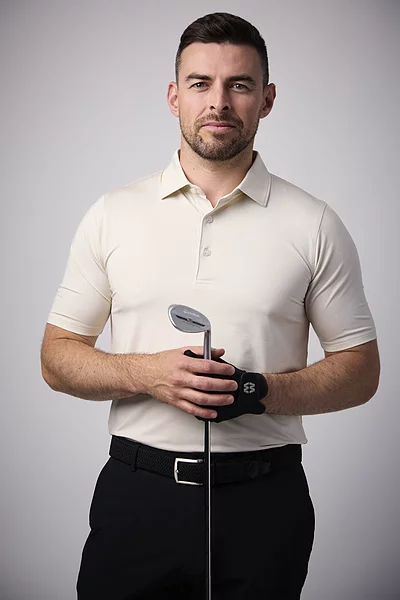
Early October is the moment to try it, when the Médoc is busy with harvest and the mornings carry a chill that has usually burned off by the turn. That makes it a quarter-zip month rather than a jacket one. A performance polo under the g.Wick midlayer, the midlayer coming off around the sixth and going back on at the eighteenth green, handles most of what a French autumn will do to you.

Nobody has full control
The best architects are admired for letting the land decide. A ridge becomes strategy. A hollow becomes a hazard. The prevailing wind makes one side of the fairway worth more than the other. Winemakers work the same way and with even less say in the matter. They cannot order a warmer September or undo a wet spring. Every season presents something different, and much of the skill lies in the response to it.
Golf, meanwhile, is full of the illusion of control. We measure to the yard, discuss launch angle and spin rate, and buy equipment built to tolerances that would satisfy a watchmaker. Then a gust arrives from nowhere, or a well-struck approach catches the wrong side of a slope and disappears somewhere it was never meant to go. Neither pursuit can be finished. There is always another round, and always another vintage.
Provence has more to say than rosé
Pale rosé has become the international calling card of Provence, and there is nothing much wrong with that, but the Var also produces the Mourvèdre-led reds of Bandol, which age for decades and bear no relation to the chilled bottle on a summer terrace.
The golf in the same département deserves the detour. Terre Blanche, at Tourrettes in the Pays de Fayence, opened in 2004 on a 300-hectare estate about half an hour inland from Cannes. Dave Thomas laid out two par-72 courses through the valleys, lakes and pine. Le Chateau, roughly 6,600 metres from the back tees, is the championship test and open to visitors playing off 35 or better. It hosted the French Riviera Masters on the European Senior Tour between 2012 and 2015. Le Riou, shorter at around 6,000 metres, is kept for members and hotel guests, runs along the hillside facing the perched villages of the Haut Var, and opens the Ladies European Tour Access Series season each year with the Terre Blanche Ladies Open. Ask most people who have played both and they will tell you Le Riou is the more enjoyable round, which says something useful about how golfers actually rank courses when nobody is listening.
Half an hour west, near the town of Vidauban, is a course most golfers will never see. Vidauban Golf Club, originally Le Prince de Provence, was Robert Trent Jones Senior's late obsession. He found the land in the 1970s while walking the scrub of the Plaine des Maures, bought it from a farmer, and spent the best part of twenty years and a great deal of his own money trying to build on it. The course opened in 1999, laid out with his son Robert Trent Jones Junior through rocky outcrops, umbrella pines and vineyards. It never hosted the tournament he had imagined. It became instead one of the most private clubs in Europe, with a membership counted in a couple of dozen families, and it still sits near the top of most rankings of French golf.
The two make a fair portrait of the Var. One of the finest courses in Europe is behind a gate that will not open, and the vineyard down the road will sell you an excellent bottle of Côtes de Provence for the price of a sandwich.

Burgundy and the importance of inches
Burgundy takes the fascination with place further still. The vineyards are extraordinarily fragmented, and two neighbouring plots can carry different classifications and produce noticeably different wine. A small change in slope matters. So does exposure, and so does the balance of limestone and clay.
To anyone who finds wine unnecessarily complicated, that degree of attention to small differences might look excessive. Golfers are in no position to complain. We will happily spend a full minute deciding whether a six-footer breaks half a cup or a full one. We know perfectly well that inches matter.
Burgundy also makes the point that scale and quality are unrelated. Some of the finest wines in the world come from very small pieces of ground, and golf has no shortage of equivalents. A course needs neither great acreage, nor a large clubhouse, nor a tournament history to be worth the journey.
A Champagne argument for patience
The traditional method was not built for the impatient. A second fermentation in bottle, ageing on the lees, disgorgement, and only then release. Decisions taken this year may not be properly understood for a decade.
Golf asks for more patience than most golfers will admit to. Improvement takes time. Courses mature. Swings change slowly, handicaps fall at a rate apparently unconnected to the amount of money spent on them, and a lesson quite often makes matters worse before anything improves. Both pursuits sit slightly out of step with an age that expects almost everything immediately.
The aphid that helped Scotch
The histories of golf and wine crossed once, in a way nobody planned. During the nineteenth century phylloxera, an aphid-like insect that arrived from North America, attacked the roots of European vines and spread through France with severe consequences. Bordeaux suffered. So did Burgundy and the Rhône. The Cognac region was hit particularly hard, and French brandy became scarce in the British market.
Scotch whisky was one beneficiary of the gap that opened up, though the popular version of this story gives the insect rather more credit than it deserves. Blending had been legalised in 1860, the Coffey still had made consistent grain spirit possible at scale, and the blending houses were marketing hard. Phylloxera helped. Scotch was already on its way.
The timing is what stays with me, because at almost exactly the same moment another Scottish export was travelling the world. By the end of the century golf clubs were appearing far beyond Scotland, following trade, empire and migration. The vines themselves eventually recovered through grafting European varieties onto resistant American rootstocks, which is how nearly every vineyard in France is planted today.

We both make it harder than it needs to be
Golf and wine share one characteristic worth being slightly embarrassed about. Both are intimidating from the outside. Golf has handicaps, etiquette, dress codes and terminology. Wine has appellations, classifications, vintages and a vocabulary of its own. And each contains the occasional enthusiast rather more interested in displaying knowledge than sharing it.
The best people in wine do the opposite. They make a complicated thing feel simple, and they would far rather you enjoyed what was in the glass than worried about identifying the correct note. The best people in golf are the same. A good professional does not make a nervous beginner feel small on the first tee. Knowledge ought to deepen the pleasure rather than serve as the price of admission.
Four hours
For all the talk of terroir and weather and craft, the strongest connection between the two is simpler than any of it. Golf gives us something increasingly hard to find, which is time. Four people spend four hours together. Sometimes they discuss golf. Often they discuss everything except golf. Friendships form that way. So do business relationships, and so do conversations between parents and children that would never have happened across a kitchen table.
Then the round finishes and everyone sits down, which is where wine takes over. The round is replayed. The missed putt on sixteen grows steadily more unlucky. A drive of perhaps 245 yards has reached 275 by the time the main course arrives, and another glass has been known to add ten yards to it. The conversation keeps going, which is the point. Golf makes the time and wine extends it.
If you want to test the theory, the Médoc in early October is as good a place to start as any. Play Les Châteaux in the morning, find an estate that afternoon, ideally one without the grandest gates, and ask whoever is pouring what the weather did to the fruit this year. You will get a longer and better answer than you would about the golf.
